
In both residential water purification systems and large-scale industrial fluid processing, maintaining the integrity of your filtration setup is paramount. A common yet critical challenge operators and technicians face is knowing exactly how to identify a water filter cartridge when it comes time for replacement or system upgrades. Using the incorrect cartridge can lead to severe pressure drops, inadequate contaminant removal, and premature equipment failure. From our experience in the manufacturing sector, understanding the physical and structural properties of these components is the only reliable way to ensure system compatibility and performance.
About HENGTENG Machine: Hengteng Environmental Technology Co., Ltd. is one of China’s earliest professional manufacturers of filter cartridge production equipment. With over 35 years of experience, we provide complete filter production line solutions to global clients in more than 60 countries. Because we design and build the machinery that produces these exact filters, we possess an intimate understanding of their structural anatomy. We recommend approaching the identification process systematically. By examining dimensions, materials, and manufacturing signatures, you can accurately identify a water filter cartridge even if the original labeling has worn off. Below are our seven expert tips to help you master this process.
Table of Contents
- Tip 1: Measure the Exact Physical Dimensions
- Tip 2: Examine the End Cap Configurations
- Tip 3: Determine the Filtration Media and Manufacturing Process
- Tip 4: Evaluate the Micron Rating and Pore Structure
- Tip 5: Inspect the Inner Core and Structural Support
- Tip 6: Assess the Weight and Density Profiling
- Tip 7: Match the Cartridge to the Application Environment
- Summary Table: Filter Identification Matrix
- Frequently Asked Questions (FAQs)
- Industry References
Tip 1: Measure the Exact Physical Dimensions
When you need to identify a water filter cartridge, the most fundamental starting point is recording its exact physical dimensions. Standardized sizing governs the filtration industry, which makes this step highly reliable. You must measure both the overall length and the outer diameter of the unit.
In terms of length, standard industry cartridges typically measure 10 inches, 20 inches, 30 inches, or 40 inches. However, precision is key; a nominal 10-inch filter might actually measure 9.75 inches or 9.875 inches depending on the housing it was designed for. We recommend using a digital caliper for exact measurements. Outer diameters are generally categorized into two main groups: standard slim-line filters which measure approximately 2.5 inches in diameter, and high-capacity filters (often referred to as Big Blue filters) which measure approximately 4.5 inches in diameter. Knowing these dimensions instantly narrows down your replacement options and is the first crucial step to successfully identify a water filter cartridge.
Tip 2: Examine the End Cap Configurations
The ends of the filter dictate how it seals within the housing to prevent fluid bypass. To accurately identify a water filter cartridge, you must observe whether both ends are identical or if they feature specific adapters. There are two primary categories in industrial and residential filtration: Double Open End (DOE) and Single Open End (SOE).
A DOE cartridge has flat, open gaskets on both ends. This relies on the knife-edge seal of the filter housing pressing directly into the gaskets. On the other hand, an SOE cartridge will have one sealed end (often capped with a flat or finned piece of polypropylene) and one open end fitted with O-rings (such as 222 or 226 O-ring configurations). From our experience engineering production lines, the type of end cap is firmly dictated by the operating pressure of the system. High-purity and high-pressure applications almost exclusively use SOE configurations with dual O-rings to guarantee a perfect seal.
Tip 3: Determine the Filtration Media and Manufacturing Process
The core material of the filter dictates its function. To identify a water filter cartridge correctly, you must analyze the media visually and texturally. As a manufacturer of advanced production equipment, we categorize these media into three primary types, each produced by specific machinery:
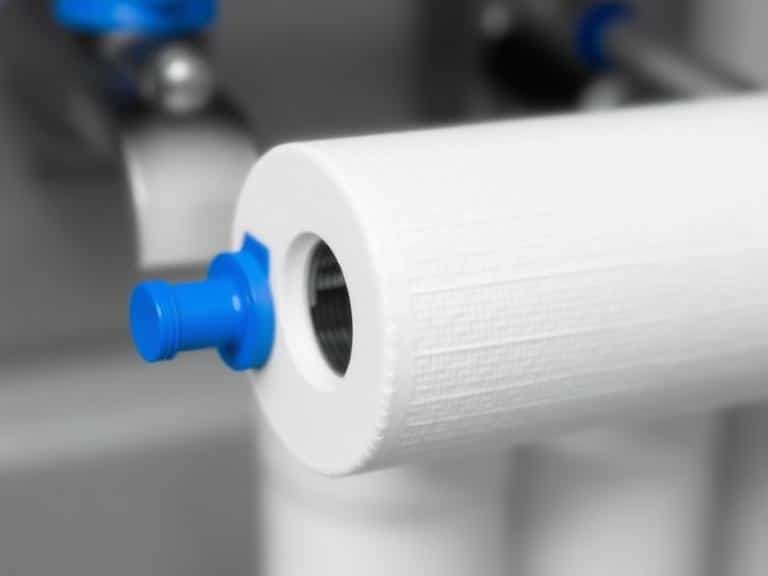
- Melt Blown Polypropylene: These filters look like smooth, solid cylinders of dense white foam. They are exceptional for removing silt, rust, and suspended solids. We engineer the exact PP filter making machine used by global manufacturers to extrude and thermally bond these continuous microfibers into a gradient density structure.
- Carbon Block: These are solid, heavy, dark grey or black cylinders, sometimes wrapped in a thin pre-filtration mesh. They are used for removing chlorine, volatile organic compounds (VOCs), and foul odors. The density and uniformity of these filters are achieved through highly specialized compression and extrusion equipment, such as our CTO carbon block filter making machine.
- String Wound: Characterized by a distinctive diamond-shaped pattern of yarn tightly wrapped around a central core. These provide excellent dirt-holding capacity and are ideal for high-sediment environments. To identify a water filter cartridge of this type, observe the tension and spacing of the yarn, which is meticulously controlled by advanced equipment like our PP yarn winding filter making machine.
Tip 4: Evaluate the Micron Rating and Pore Structure
The micron rating defines the size of the particles the filter can effectively capture. While it is easy to identify a water filter cartridge when the micron rating is printed clearly on the outer shrink wrap, this information is often lost after months of submersion in water. If the label is gone, you can infer the micron rating through careful visual inspection.
From our experience, string wound and melt blown filters utilize a gradient density structure. This means the outer layers are looser to catch larger particles (like 50 microns), while the inner layers near the core are tighter to catch finer particles (down to 1 or 5 microns). If the exterior of a melt-blown filter feels highly rigid and tightly packed, it is likely a low-micron filter (1 to 5 microns). If the exterior yields slightly to pressure and appears fibrous, it is likely a higher micron rating (10 to 50 microns). We recommend replacing filters with the exact or a slightly tighter micron rating based on your system’s pressure capabilities.
Tip 5: Inspect the Inner Core and Structural Support
Not all filters require an inner core, and the presence or absence of one is a strong clue when you need to identify a water filter cartridge. The inner core provides structural integrity against differential pressure, preventing the filter from collapsing inward as it becomes loaded with sediment.
Melt blown PP filters manufactured on high-end extrusion lines often do not require a separate inner core because the thermal bonding process creates a self-supporting rigid inner matrix. However, string wound filters absolutely require a core (usually made of molded polypropylene or tinned steel) to give the yarn a foundation to wrap around. CTO carbon blocks usually feature a thin inner core wrapped in a spun-bond material to prevent carbon fines from migrating into the filtered water stream. Observing the core material helps identify a water filter cartridge and guarantees you select a replacement that can withstand your system’s operating pressure.
Tip 6: Assess the Weight and Density Profiling
Sometimes, visual inspection alone is insufficient to identify a water filter cartridge, especially when comparing two carbon blocks or two tightly wound PP filters of the same dimension. In these cases, assessing the physical weight and density is an expert diagnostic technique.
For example, a CTO carbon block filter that feels unusually light may contain a high percentage of cheaper binders rather than high-quality activated coconut shell carbon. When produced correctly on a premium CTO carbon block filter making machine, the resulting cartridge is dense, heavy, and structurally sound. Similarly, a 1-micron PP melt blown filter will weigh noticeably more than a 50-micron filter of the same dimensions because more polymer mass is extruded into the same volumetric space to create smaller pores. We recommend comparing the weight of your old, dried-out filter against potential replacements to ensure you are maintaining the required density.
Tip 7: Match the Cartridge to the Application Environment
Finally, to fully identify a water filter cartridge, you must contextualize it within the application environment. Filters are engineered specifically for their operating conditions. A reverse osmosis (RO) pre-filter operates under very different conditions than a whole-house point-of-entry sediment filter.
If the filter was pulled from the first stage of a residential RO system, it is almost certainly a 5-micron PP melt blown filter produced by a PP filter making machine, designed to protect the subsequent carbon and membrane stages from heavy particulates. If the filter was pulled from a high-temperature industrial chemical bath, it is likely a specialized string wound filter manufactured with cotton or glass fiber yarn on a robust PP yarn winding filter making machine, complete with a stainless steel core. Understanding the fluid type, temperature, and desired outcome confirms your physical findings and helps you confidently identify a water filter cartridge for reordering.
Summary Table: Filter Identification Matrix
To streamline the identification process, we have compiled the key characteristics discussed above into a quick-reference matrix. Use this table alongside our seven tips to accurately identify a water filter cartridge in the field.
| Filter Media Type | Visual Appearance | Typical Core Structure | Primary Contaminant Target | Associated HENGTENG Equipment |
|---|---|---|---|---|
| Melt Blown Polypropylene | Smooth, white, dense foam-like cylinder | Usually coreless (self-supporting) | Sand, silt, rust, suspended solids | PP filter making machine |
| CTO Carbon Block | Solid, heavy, dark grey/black, mesh wrap | Thin PP inner core with spun wrap | Chlorine, VOCs, odors, bad taste | CTO carbon block filter making machine |
| String Wound Polypropylene | Diamond-patterned wrapped yarn | Rigid PP or stainless steel core | Heavy sediment, high-temperature fluids | PP yarn winding filter making machine |
Frequently Asked Questions (FAQs)
From our experience, you should rely on physical dimensions and media type. Measure the exact length and outer diameter. Then, look at the material: if it is wrapped yarn, it is string wound; if it is solid white and foam-like, it is melt-blown; if it is heavy and black, it is a carbon block.
In some industrial applications, color-coded end caps are used to identify a water filter cartridge’s micron rating (e.g., blue for 1 micron, red for 5 micron). However, this is not a universal standard. We recommend confirming the micron rating via the supplier’s specifications based on the physical dimensions and media type.
Understanding the manufacturing origin—such as whether a filter was extruded on a PP filter making machine or wound on a PP yarn winding filter making machine—helps you understand the filter’s structural limitations, pressure drop characteristics, and ideal use-case environments.
Yes, as long as the dimensions (length and diameter) and the micron rating match your system requirements. However, string wound filters generally offer higher dirt-holding capacity for larger particulates, while melt blown filters provide more precise, consistent depth filtration for finer particles.
Industry References
To further support your operational knowledge and ensure your filtration systems meet global standards, we recommend reviewing the guidelines set forth by leading regulatory and standardization bodies:
- NSF International – For standards regarding the material safety and structural integrity of drinking water treatment units.
- Water Quality Association (WQA) – For best practices, certifications, and educational resources regarding residential and commercial water treatment.
- International Organization for Standardization (ISO) – For global manufacturing quality management standards (ISO 9001) applicable to filter cartridge production equipment.