
The global water purification industry relies entirely on precise dimensional uniformity to ensure that consumable components integrate flawlessly with diverse filtration housings. For original equipment manufacturers, facility engineers, and regional distributors, possessing a deep technical understanding of the standard sizes of water filter cartridges is a fundamental requirement. Failure to adhere to these strict dimensional tolerances results in hydraulic bypass, severe pressure loss, and catastrophic system contamination. At HENGTENG Machine, we have engineered and refined the mechanical equipment that dictates these industry dimensions for decades.

Hengteng Environmental Technology Co., Ltd. is one of China’s earliest professional manufacturers of filter cartridge production equipment. With over 35 years of experience, we provide complete filter production line solutions to global clients in more than 60 countries. Because we design the exact machinery that extrudes, compresses, and winds these products, our perspective is deeply rooted in manufacturing reality. From our experience, optimizing production lines to effortlessly transition between the standard sizes of water filter cartridges is the defining factor in a manufacturer’s profitability and market responsiveness.
In this authoritative technical guide, we will dissect the specific measurements, engineering tolerances, and application requirements of the standard sizes of water filter cartridges. We will also detail how advanced machinery adapts to produce these universal formats, ensuring you possess the actionable intelligence required to scale your filtration business.
Table of Contents
- 1. The Engineering Logic Behind the Standard Sizes of Water Filter Cartridges
- 2. Analyzing the Dimensional Metrics: Lengths and Diameters
- 3. Manufacturing the Standard Sizes of Water Filter Cartridges
- 4. Application Engineering: Selecting the Right Dimensions
- 5. Summary Table: Standard Sizes of Water Filter Cartridges
- 6. Frequently Asked Questions (FAQs)
- 7. Industry References
1. The Engineering Logic Behind the Standard Sizes of Water Filter Cartridges
Before the widespread adoption of universal parameters, the filtration market was fragmented by proprietary dimensions. This lack of uniformity restricted consumer choice and created logistical nightmares for suppliers. The standardization of cartridge dimensions resolved this by establishing a predictable engineering framework. When evaluating the standard sizes of water filter cartridges, professionals must understand that these dimensions are dictated primarily by internal housing volumes and fluid dynamics.
Standardization enables interchangeability. A reverse osmosis pre-filter manufactured on our machinery in Asia will perfectly seal inside a residential housing unit molded in North America. We recommend adhering strictly to the standard sizes of water filter cartridges because any deviation—even by a fraction of an inch—can prevent the cartridge from seating securely against the housing’s knife-edge seal. From our experience, ensuring your production lines are calibrated to these exact global standards is the only way to guarantee product performance and avoid costly client rejections.
2. Analyzing the Dimensional Metrics: Lengths and Diameters
To accurately categorize the standard sizes of water filter cartridges, we must break down the measurements into lengths and outside diameters (OD). These two metrics dictate the total surface area available for particulate retention and chemical adsorption.
Nominal vs. Actual Lengths
The industry classifies cartridge lengths nominally, but the actual physical measurements are distinctly different to allow for internal housing clearance. The dominant length categories within the standard sizes of water filter cartridges include:
- 10-Inch Cartridges: The absolute baseline for point-of-use (POU) systems. While called 10-inch, the actual length typically measures 9.75 inches or 9.875 inches.
- 20-Inch Cartridges: Utilized in point-of-entry (POE) and light commercial systems. The actual length is generally 20 inches exactly, designed for higher flow rates.
- 30-Inch and 40-Inch Cartridges: These extended lengths are strictly utilized in industrial multi-round housings. Producing these requires immense structural integrity to prevent the cartridge from bowing under high differential pressure.
Standard (Slim) vs. Big Blue (High Capacity) Diameters
Alongside length, the outside diameter is the second critical component of the standard sizes of water filter cartridges. The market is bisected into two primary diameter categories:
- Standard / Slim Diameter (2.5 inches): The 2.5-inch OD is universally utilized for low-flow residential applications. It provides sufficient depth for municipal water treatment where sediment loads are relatively low.
- Big Blue / Jumbo Diameter (4.5 inches): Often abbreviated as BB, the 4.5-inch OD drastically increases the radial depth and surface area of the filter. We recommend utilizing the 4.5-inch diameter for whole-house filtration or heavy commercial applications, as the larger volume significantly reduces pressure drop and extends the service life between change-outs.
3. Manufacturing the Standard Sizes of Water Filter Cartridges
Producing the exact dimensions required by the global market demands highly calibrated industrial equipment. At HENGTENG Machine, we engineer our production lines to provide operators with the flexibility to quickly transition between the various standard sizes of water filter cartridges. Here is how our specialized equipment handles different filtration media:
Melt-Blown Extrusion Technology
The production of spun-bonded polypropylene (PP) cartridges relies on precise thermal extrusion. Our PP filter making machine utilizes advanced micro-processor controls to regulate the speed of the receiving spindle and the temperature of the polymer melt. To switch between a 2.5-inch standard and a 4.5-inch Big Blue diameter, the operator simply adjusts the distance of the extrusion dies and the rotational speed of the mandrel. Our PP filter making machine ensures that the density gradient remains perfectly consistent, regardless of which of the standard sizes of water filter cartridges is being produced.
Carbon Block Compression and Extrusion
Activated carbon blocks are the cornerstone of chlorine and volatile organic compound (VOC) reduction. Manufacturing these requires blending pulverized carbon with a thermoplastic binder and applying massive pressure and heat. Our CTO carbon block filter making machine is engineered with interchangeable molds and automated cutting mechanisms. From our experience, maintaining uniform porosity across a 20-inch Big Blue carbon block is incredibly challenging without highly calibrated thermal zones. We recommend our CTO carbon block filter making machine because it guarantees structural integrity across all standard sizes of water filter cartridges without carbon shedding or core collapse.
Precision Yarn Winding
String wound filters remain highly relevant for industrial applications dealing with varied micron-sized particulates. Our PP yarn winding filter making machine relies on sophisticated programmable logic controllers to dictate the roving pitch and winding tension. To produce the different standard sizes of water filter cartridges, the machine adjusts the stroke length of the yarn guide. This allows a single PP yarn winding filter making machine to seamlessly wind a 10-inch slim cartridge and then rapidly reconfigure to wind a 40-inch industrial element, ensuring perfect diamond-pattern geometry across all lengths.
4. Application Engineering: Selecting the Right Dimensions
Understanding the standard sizes of water filter cartridges is only half the equation; applying them correctly dictates system efficacy. From our experience designing factory layouts and consulting with system integrators, selecting the correct dimensions requires a strict analysis of flow rate (Gallons Per Minute) and terminal pressure drop.
For standard residential under-sink reverse osmosis systems, we recommend the 10-inch by 2.5-inch configuration. It provides a compact footprint while easily handling the 0.5 to 1.0 GPM required by residential membranes. Conversely, if an engineer is designing a whole-house filtration array, utilizing a 2.5-inch diameter will instantly choke the water pressure to the showers and appliances. In these scenarios, the 20-inch by 4.5-inch Big Blue configuration must be specified. Operating outside of these defined standard sizes of water filter cartridges forces clients to purchase custom housings, which drastically inflates capital expenditure and completely eliminates the availability of aftermarket replacement parts.
5. Summary Table: Standard Sizes of Water Filter Cartridges
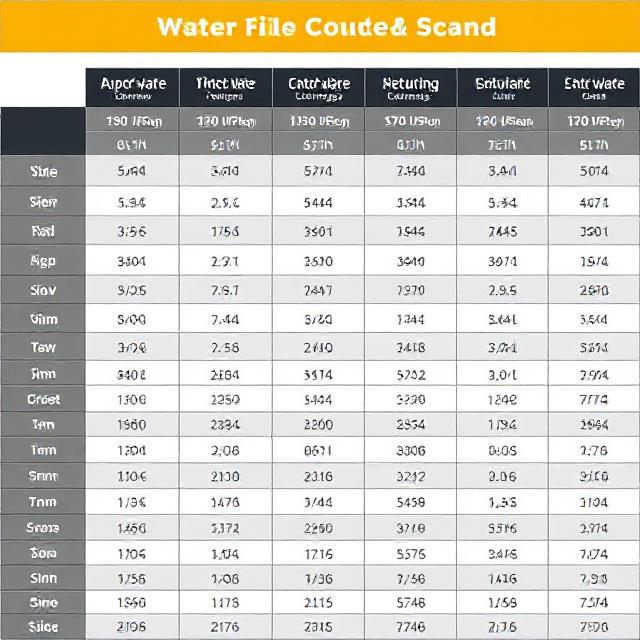
To assist procurement managers and production engineers, we have compiled a definitive summary of the standard sizes of water filter cartridges. This matrix aligns physical dimensions with expected operational flow rates based on HENGTENG Machine testing protocols.
| Industry Designation | Actual Length (Inches) | Outside Diameter (Inches) | Typical Max Flow Rate (GPM) | Primary Application Environment |
|---|---|---|---|---|
| 10″ Standard (Slim) | 9.75″ to 9.875″ | 2.5″ | 1 to 3 GPM | Residential POU, Under-sink RO, Ice Makers |
| 20″ Standard (Slim) | 20.0″ | 2.5″ | 3 to 7 GPM | Light Commercial, Beverage Equipment |
| 10″ Big Blue (BB) | 9.75″ to 9.875″ | 4.5″ | 5 to 10 GPM | Residential POE, Small Whole-House |
| 20″ Big Blue (BB) | 20.0″ | 4.5″ | 10 to 20 GPM | Large Whole-House, Commercial POE |
| 30″ Industrial | 30.0″ | 2.5″ | Variable (Multi-round) | Industrial Pre-filtration, Chemical Processing |
| 40″ Industrial | 40.0″ | 2.5″ | Variable (Multi-round) | Municipal Water Treatment, Desalination Plants |
6. Frequently Asked Questions (FAQs)
7. Industry References
- Water Quality Association (WQA): Dimensional Standards and Compatibility Guidelines for Point-of-Use and Point-of-Entry Systems.
- Industrial Fluid Processing Directives: Pressure Drop Calculations Based on Filter Cartridge Radial Depth and Length.