
In the highly exact field of industrial filtration and water purification, the structural integrity and micron precision of a polypropylene melt-blown cartridge dictate its market value. At the core of this manufacturing process is the pp filler machine. This highly specialized extrusion equipment transforms raw polypropylene (PP) resin into a continuous, multi-layered filtration matrix. As global regulations regarding water quality and industrial fluid management become increasingly stringent in 2026, relying on outdated or inefficient production hardware is no longer a viable operational strategy.
Authored by the engineering team at HENGTENG Machine. Since 1989, we have been a leading manufacturer of filter cartridge machines, providing high-efficiency, smart control, and ISO certified industrial solutions. Trusted globally, we specialize in advanced extrusion technology and offer comprehensive global service to optimize your filtration production lines.
From our experience engineering advanced melt-blown extrusion systems at HENGTENG Machine, we recognize that selecting the optimal pp filler machine is the most critical procurement decision a filter manufacturer can make. A superior machine ensures uniform fiber distribution, precise micron ratings, and continuous 24-hour operation without unexpected downtime. In this authoritative technical guide, we will analyze the fundamental mechanics of melt-blown technology, evaluate the critical criteria for machinery selection, and detail the 5 best pp filler machine models available to maximize your production yield and product consistency.
Table of Contents
- 1. Understanding the Mechanics of a PP Filler Machine
- 2. Expert Criteria for Selecting a PP Filler Machine
- 3. The 5 Best PP Filler Machine Models in 2026
- 4. Operational Optimization and Cooling Protocols
- 5. Summary Table: Top PP Filler Machine Specifications
- 6. Frequently Asked Questions (FAQs)
- 7. Industry References
1. Understanding the Mechanics of a PP Filler Machine
To accurately evaluate a pp filler machine, one must first understand the thermodynamic and kinetic processes it executes. The machine begins by feeding raw polypropylene granules into a heated extruder barrel. Inside the barrel, a precisely machined screw shears and melts the polymer. The molten plastic is then forced through a specialized die head containing hundreds of microscopic orifices.
As the polymer exits the die, high-velocity hot air streams intersect the extrusion, drawing the molten plastic into ultra-fine microfibers. These fibers are blown onto a rotating receiving mandrel, where they self-bond and cool to form the cylindrical structure of the filter cartridge. We recommend monitoring the air temperature and velocity meticulously, as these variables directly control the fiber diameter and, consequently, the final filter precision of the cartridge produced by the pp filler machine.
2. Expert Criteria for Selecting a PP Filler Machine
Not all extrusion systems are engineered to the same tolerances. When evaluating a pp filler machine for your facility, we recommend focusing on three core technical pillars: control architecture, production stability, and dimensional flexibility.
First, the control architecture is paramount. A modern pp filler machine must utilize a fully automatic Programmable Logic Controller (PLC) integrated with precision frequency converters. This allows operators to fine-tune the extruder speed, hot air temperature, and winding tension in real-time. Second, production stability defines your profitability. The equipment must be capable of continuous 24-hour operation without suffering from die-head clogging or thermal fluctuations. Finally, dimensional flexibility ensures your facility can respond to shifting market demands. A top-tier pp filler machine should effortlessly switch between producing 10-inch, 20-inch, 30-inch, and 40-inch filter lengths while accommodating various inner and outer diameter specifications.
3. The 5 Best PP Filler Machine Models in 2026
Based on extrusion efficiency, power consumption, structural durability, and the ability to produce gradient-density filters, we have curated the definitive list of the top hardware solutions available to manufacturers this year.
1. HENGTENG 3E3M PP Melt Blown Filter Making Machine
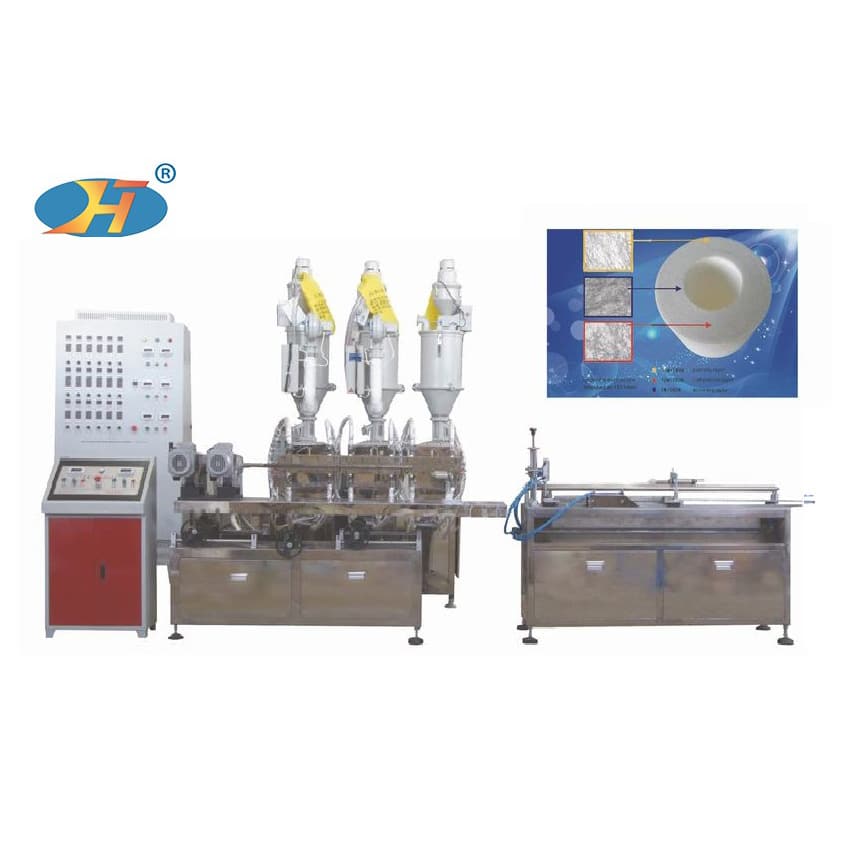
At the absolute forefront of industrial filtration manufacturing is the HENGTENG 3E3M model. From our experience, this pp filler machine represents the pinnacle of high-volume, precision manufacturing. Operating with three extruders and three molds (3E3M), it allows for the simultaneous creation of a three-tier gradient density structure within a single filter cartridge. This gradient matrix traps larger particles on the exterior and finer particles in the core, massively increasing the dirt-holding capacity and lifespan of the filter.
The 3E3M pp filler machine achieves an impressive production speed of 0.6 to 0.8 meters per minute. Despite this high output, it maintains a highly efficient rated power of 34 kW per set. The fully automatic PLC and frequency converter control system ensures seamless operation. Designed for continuous 24-hour operation, this machine supports filter lengths ranging from 10 inches to 40 inches (customizable) and offers optional air cooling or water cooling methods to suit your specific facility layout.
2. HENGTENG 1.2e2mPP Melt-blown Filter Cartridge Machine

For mid-to-large scale operations requiring exceptional versatility, the HENGTENG 1.2e2mPP model is an outstanding pp filler machine. This configuration is specifically engineered to deliver absolute precision across a vast spectrum of micron ratings. By adjusting the smart control parameters, operators can achieve filter precision ranging from ultra-fine 1 micron up to 100 microns (1μm, 5μm, 10μm, 20μm, 30μm, 50μm, 100μm).
This pp filler machine operates with a low power consumption of 30KW/h, maximizing your energy efficiency and lowering the cost per unit. It offers an inner diameter range of 10mm to 150mm (with a standard default of 28mm) and an outer diameter range of 38mm to 120mm. Supporting standard filter lengths of 10, 20, 30, and 40 inches, the 1.2e2mPP runs on AC380V/Hz or DC220V/50Hz, with customizable voltage options available for global deployment.
3. Advanced 2E3M Multi-Stage PP Filler Machine
The 2E3M configuration utilizes two extruders feeding into three mold stages. This pp filler machine is highly favored by facilities that require rapid changeovers between different product lines. By utilizing two massive extrusion barrels, it provides excellent melt homogeneity, which is crucial when processing lower-grade or recycled polypropylene resins. We recommend this setup for manufacturers supplying the agricultural and heavy industrial sectors where dual-gradient filtration is sufficient.
4. Compact 1E1M Laboratory PP Filler Machine
Not every operation requires massive industrial throughput. For research and development laboratories, university engineering departments, and boutique specialty filter manufacturers, the 1E1M pp filler machine is the ideal choice. Featuring a single extruder and a single mold, this compact unit allows engineers to test new polymer blends, prototype custom filter geometries, and conduct destructive testing without halting the primary mass-production lines.
5. High-Capacity Quad-Extruder PP Filler Machine
Rounding out our list is the heavy-duty quad-extruder configuration. Designed strictly for hyper-scale municipal water treatment suppliers, this massive pp filler machine utilizes four independent extruders to create highly complex, four-tier filtration matrices. While the capital expenditure and physical footprint of this machine are substantial, its ability to produce highly specialized absolute-rated cartridges makes it a powerhouse in the advanced filtration market.
4. Operational Optimization and Cooling Protocols
Acquiring a premier pp filler machine is only the first step; optimizing its operation ensures long-term profitability. A critical aspect of melt-blown manufacturing is the cooling phase. Polypropylene exits the die head in a molten state and must be rapidly cooled to preserve the micro-structure of the fibers.
We recommend carefully evaluating whether to deploy air cooling or water cooling systems. Air cooling relies on high-velocity ambient or chilled air fans. It is the standard for most operations and requires less maintenance. However, in regions with extreme ambient heat and humidity, water cooling (where the receiving mandrel is internally chilled via a closed-loop water chiller) provides a much faster and more consistent thermal draw. Both the HENGTENG 3E3M and the 1.2e2mPP models are designed to integrate seamlessly with either cooling method, ensuring your pp filler machine operates at peak efficiency regardless of your geographical climate.
5. Summary Table: Top PP Filler Machine Specifications
To assist your procurement engineers in comparing the leading options, we have consolidated the technical specifications of our top recommended models.
| Machine Model | Extrusion Setup | Rated Power | Production Speed | Filter Precision | Key Feature |
|---|---|---|---|---|---|
| HENGTENG 3E3M | 3 Extruders, 3 Molds | 34 kW/set | 0.6 – 0.8 m/min | Gradient (1μm – 100μm) | Continuous 24-hour operation, Fully Auto PLC |
| HENGTENG 1.2e2mPP | 2 Extruders, 2 Molds | 30 KW/h | Variable | 1μm to 100μm | Wide ID/OD range, highly energy efficient |
| Advanced 2E3M | 2 Extruders, 3 Molds | ~32 kW/set | 0.5 – 0.7 m/min | Dual Gradient | Rapid line changeovers, robust melt homogeneity |
| Compact 1E1M | 1 Extruder, 1 Mold | ~15 kW/set | 0.2 – 0.4 m/min | Single Density | Small footprint, ideal for R&D prototyping |
| Quad-Extruder | 4 Extruders, Multiple Molds | >45 kW/set | >1.0 m/min | Complex Gradient | Hyper-scale municipal production capacity |