
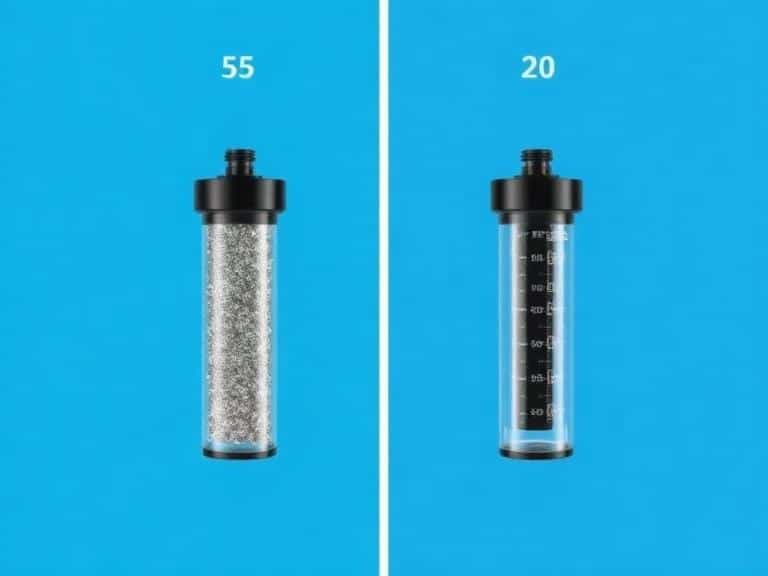
For homeowners relying on private wells, sediment filtration is not a luxury; it is a necessity. The decision often comes down to a single number printed on a cartridge wrapper: the micron rating. A common dilemma we encounter in the field is the choice between a 5 micron or 20 micron for well water filtration. Choosing the wrong size can lead to two frustrating outcomes: either your water remains cloudy (filtration too loose), or your water pressure drops to a trickle (filtration too tight).
From our experience at Hengteng Machine—where we have been manufacturing the equipment that produces these filter cartridges since 1989—the answer is rarely a simple “A is better than B.” It is about matching the internal structure of the filter to the geology of your groundwater.
This article provides an authoritative breakdown of when to use each micron rating, how to balance flow rate with water clarity, and why the manufacturing method (melt blown vs. string wound) is just as important as the micron number itself.
Table of Contents
- 1. Understanding Microns: The Scale of Sediment
- 2. The 20 Micron Filter: The Heavy Lifter
- 3. The 5 Micron Filter: The Polisher
- 4. The Expert Verdict: Which Should You Choose?
- 5. Manufacturing Insight: Why Filter Structure Matters
- 6. Managing Pressure Drop vs. Filtration Quality
- 7. Step-by-Step Selection Guide
- 8. Summary Comparison Table
- 9. Frequently Asked Questions
1. Understanding Microns: The Scale of Sediment
To make an informed decision, we must first visualize what a “micron” represents. A micron (micrometer) is one-millionth of a meter. To put this in perspective regarding well water contaminants:
- 100 Microns: Human hair diameter.
- 50-75 Microns: Visible sand grains.
- 20 Microns: Silt, pollen, and large dust. Visible to the naked eye as “haziness.”
- 5 Microns: Red blood cells, fine silt, and some bacteria cysts. Generally invisible individually, but creates turbidity (cloudiness).
When you choose a filter rating, you are effectively choosing the size of the holes in the sieve. A 20 micron filter lets anything smaller than 20 microns pass through. A 5 micron filter stops much finer particles but creates significantly more resistance to water flow.
2. The 20 Micron Filter: The Heavy Lifter
In the context of well water, a 20 micron filter acts as a “gatekeeper.” It is designed to stop the heavy artillery: sand, rust flakes, and grit that can destroy washing machines, dishwasher valves, and faucet aerators.
When to use 20 micron:
- Visible Debris: If you can see grains of sand at the bottom of a glass of water.
- High Sediment Load: If your well pumps up a lot of dirt, a finer filter would clog in days.
- Pressure Priority: If your well pump is weak, a 20 micron filter offers less resistance (pressure drop) than a 5 micron filter.
We recommend starting with a 20 micron filter if you have never filtered your well before. It provides a baseline of protection without drastically killing your flow rate.
3. The 5 Micron Filter: The Polisher
A 5 micron filter creates “polished” water. It captures fine silt and clay that a 20 micron filter would miss. This is the standard requirement for protecting sensitive downstream equipment.
When to use 5 micron:
- UV Pre-Filtration: If you use a UV disinfection system, a 5 micron filter is mandatory. Anything larger allows shadows (from particles) where bacteria can hide from the UV light.
- Water Softener Protection: Fine silt can ruin the resin bed of a water softener. A 5 micron pre-filter extends the softener’s life.
- Cloudy Water: If your water has no visible sand but looks “milky” or hazy, you are dealing with fine particulates that require 5 micron filtration.
4. The Expert Verdict: Which Should You Choose?
The answer to “5 micron or 20 micron for well water” is frequently: Both, or a Dual-Gradient solution.
From our extensive experience in filter production lines, relying on a single uniform density filter is inefficient for well water. Well water contains a mix of particle sizes. Using a single 5 micron filter means the surface gets plugged with large sand grains immediately, wasting the inner layers of the filter. Using only a 20 micron filter leaves the water cloudy.
The Best Practice Strategy:
- Two-Stage Approach: Install two filter housings in series. The first contains a 20-50 micron filter (to catch sand). The second contains a 5 micron filter (to polish the water). This maximizes the lifespan of both cartridges.
- Dual-Gradient Cartridges: These are advanced filters manufactured with varying densities—loose on the outside (e.g., 25 micron) and tight on the core (e.g., 5 micron). This allows the entire depth of the filter to capture dirt, rather than just the surface.
5. Manufacturing Insight: Why Filter Structure Matters

As a global leader in filter cartridge production equipment, Hengteng Machine understands that the *method* of manufacturing determines the filter’s performance just as much as the micron rating.
String Wound Filters (The Workhorse)
Produced by our PP yarn winding filter making machine, these filters consist of yarn wound around a core in a precise diamond pattern. They are exceptional for heavy well sediments.
- Advantage: They have a massive dirt-holding capacity. The “fuzzy” fibers trap irregular particles like sand and rust without blocking flow immediately.
- Best For: First-stage filtration (20 micron) in wells with sand or variable sediment loads.
Melt Blown Filters (The Precision Tool)
Produced by our PP filter making machine, these are made by blowing molten polymer onto a rotating shaft. This creates a bonded web of fibers.
- Advantage: They offer precise filtration and do not allow “unloading” (releasing trapped dirt) under pressure surges. They can be engineered with a true density gradient (loose outer, tight inner).
- Best For: Second-stage filtration (5 micron) or applications requiring high purity.
6. Managing Pressure Drop vs. Filtration Quality
Pressure drop is the difference in water pressure before the filter and after the filter. As a filter does its job (trapping dirt), pressure drop increases. This is the main complaint of well owners.
A 5 micron filter has smaller pores, creating higher initial resistance. If your well pump pressure switch is set to 40/60 psi, a clogged 5 micron filter can easily drop your shower pressure to an unusable level. A 20 micron filter has larger pores, allowing water to pass freely even as it accumulates a significant load of sand.
Pro Tip: To use a 5 micron filter without sacrificing pressure, use a “Big Blue” style housing (4.5 inches wide) rather than a standard slim housing (2.5 inches wide). The increased surface area dramatically improves flow rate.
7. Step-by-Step Selection Guide
If you are setting up a filtration system today, follow this decision matrix:
- Scenario A: Visible Sand / Grit.
Recommendation: Use a 20 micron String Wound filter. String wound filters have superior capacity for holding large grains.
- Scenario B: Hazy Water / Silt.
Recommendation: Use a 5 micron Melt Blown filter. This will clear the turbidity. If it clogs too fast, install a 20 micron filter before it.
- Scenario C: Pre-treatment for Softener or UV.
Recommendation: You must end with 5 micron. Use a gradient density cartridge (25 to 5 micron) to prevent pressure loss.
- Scenario D: City Water (Chlorine taste).
Recommendation: Micron rating matters less here; focus on Carbon Block filters. Our CTO carbon block filter making machine produces filters specifically for chemical reduction rather than sediment.
8. Summary Comparison Table
| Feature | 20 Micron Filter | 5 Micron Filter |
|---|---|---|
| Primary Target | Sand, Rust Flakes, Grit | Silt, Clay, Fine Sediment |
| Flow Rate | High (Low resistance) | Medium/Low (Higher resistance) |
| Clogging Speed | Slow | Fast (if water is dirty) |
| Best Filter Type | String Wound (Depth) | Melt Blown or Pleated |
| System Position | Stage 1 (Pre-filter) | Stage 2 (Final Polish) |
| Required for UV? | No (Not fine enough) | Yes (Mandatory) |
9. Frequently Asked Questions
Can I wash and reuse my well water filter?
Generally, no. Melt blown and string wound filters act as “depth” filters; the dirt is trapped deep inside the core. Washing the outside does not clean the inside. Pleated polyester filters can be rinsed a few times, but for sanitary reasons, regular replacement is recommended.
What is the difference between Nominal and Absolute ratings?
For well water, almost all filters are Nominal. This means a “5 micron nominal” filter captures roughly 85% of 5-micron particles. An Absolute rating means it captures 99.9% of particles at that size. Absolute filters are expensive and typically reserved for medical or industrial use, not residential wells.
Why does my water pressure drop even with a new filter?
If a new filter restricts pressure, the micron rating is likely too fine for the flow rate of your pump, or the filter housing is too small. Switch to a larger micron rating (e.g., go from 5 to 20) or upgrade to a larger filter housing (Big Blue) to increase surface area.
How do Hengteng machines influence filter quality?
Quality control in the manufacturing process is vital. Machines like our PP melt blown filter cartridge machine utilize advanced control systems to ensure the fiber diameter is consistent. If a manufacturer uses poor equipment, a “5 micron” filter might actually have gaps of 20 microns, letting dirt pass through. High-quality production equipment ensures the rating on the label matches the performance in your home.