
In the highly technical realm of industrial liquid filtration, plant engineers and procurement managers constantly face a critical decision regarding their depth filtration media. The ongoing debate of Melt blown filter vs string wound cartridges represents more than just a purchasing choice; it is a fundamental engineering decision that directly impacts fluid purity, system pressure drops, maintenance intervals, and overall operational costs. Selecting the incorrect filter architecture can lead to catastrophic downstream contamination, premature pump wear, and unacceptable product quality.
Hengteng Environmental Technology Co., Ltd. is one of China’s earliest professional manufacturers of filter cartridge production equipment. With over 35 years of experience, we provide complete filter production line solutions to global clients in more than 60 countries. From our experience designing and commissioning advanced manufacturing lines, we possess a microscopic understanding of how these filter matrices are constructed and how they perform under rigorous industrial conditions. In this comprehensive technical analysis, we will deconstruct the Melt blown filter vs string wound comparison, providing you with the authoritative data required to optimize your filtration processes.
Table of Contents
- 1. Understanding the Fundamentals of Depth Filtration
- 2. Structural Analysis: Melt Blown Filter vs String Wound
- 3. Performance Metrics and Filtration Efficiency
- 4. The Impact of Manufacturing Technology
- 5. Practical Application Guide: Which to Choose?
- 6. Summary Table: Melt Blown Filter vs String Wound
- 7. Frequently Asked Questions (FAQs)
- 8. References
1. Understanding the Fundamentals of Depth Filtration
Before analyzing the Melt blown filter vs string wound dynamics, it is essential to understand the mechanics of depth filtration. Unlike surface filters (such as pleated paper or membrane filters) that trap particles strictly on their exterior surface, depth filters capture contaminants throughout the entire thickness of the filter media. The fluid is forced through a complex, tortuous path of fibers. As particles navigate this labyrinth, they become trapped within the matrix via mechanical interception, inertial impaction, and electrokinetic adsorption.
Both melt blown and string wound cartridges operate on this depth filtration principle. However, the manner in which they construct this tortuous path differs drastically, leading to significant variations in performance. The Melt blown filter vs string wound debate essentially boils down to comparing a thermally bonded, multi-layered microfiber structure against a geometrically woven yarn structure. We recommend evaluating your fluid’s viscosity, particulate load, and acceptable bypass tolerance before deciding between the two.
2. Structural Analysis: Melt Blown Filter vs String Wound
The Architecture of Melt Blown Filters
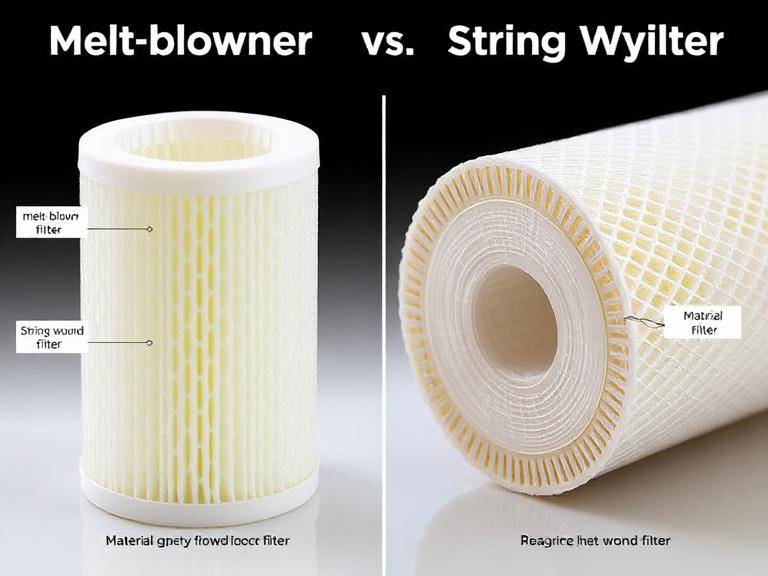
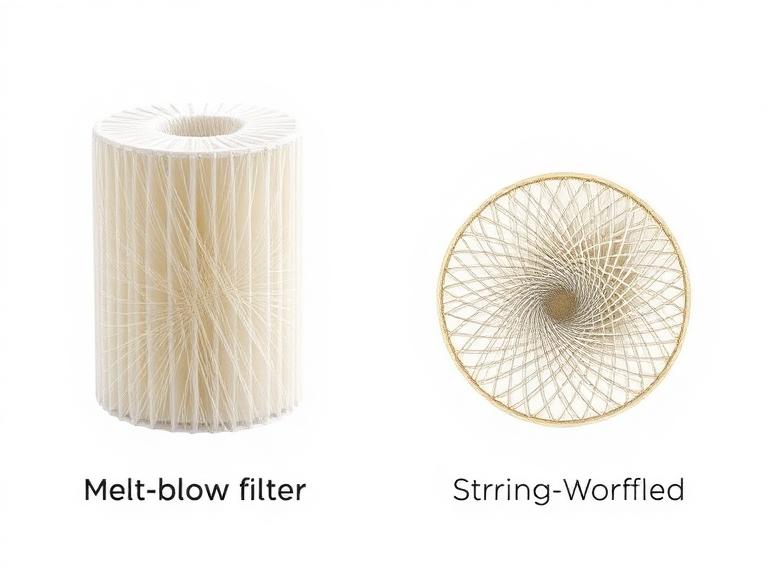
Melt blown filter cartridges are manufactured through a highly precise polymer extrusion process. Polypropylene resin is melted and extruded through microscopic nozzles into a high-velocity airstream. This hot air attenuates the extruded polymer into ultra-fine microfibers, which are immediately collected onto a rotating spindle. Because the fibers are still in a semi-melted state when they make contact, they thermally bond to one another at their intersection points.
This thermal bonding is the defining characteristic in the Melt blown filter vs string wound comparison. It creates a rigid, highly stable, continuous cylindrical matrix without the need for inner cores (in most standard applications) or chemical binders. Furthermore, modern manufacturing allows for a graded-density structure. By altering the extrusion parameters during production, the filter is built with larger pores on the outside to catch coarse debris, and progressively tighter pores toward the inner core for fine filtration. This maximizes the utilization of the entire filter depth.
The Architecture of String Wound Filters
String wound filters, also known as yarn-wound filters, represent a much older, more traditional technology. They are manufactured by tightly winding a continuous yarn—which can be made from polypropylene, cotton, glass fiber, or polyester—around a rigid central core (usually made of perforated plastic or stainless steel). The yarn is wound in a highly specific diamond pattern.
The filtration rating in a string wound cartridge is determined by the thickness of the yarn and the tension and spacing of the winding pattern. Fluid travels through the diamond-shaped openings and penetrates the yarn itself. While this creates an effective depth filter, the structure relies entirely on the mechanical tension of the winding. There is no thermal or chemical bonding holding the individual yarn fibers in place.
3. Performance Metrics and Filtration Efficiency
When plant managers consult with us regarding the Melt blown filter vs string wound choice, the conversation inevitably turns to critical performance metrics. From our experience, the structural differences outlined above translate into starkly different operational behaviors on the factory floor.
Media Migration and Structural Integrity
One of the most critical factors in the Melt blown filter vs string wound debate is media migration—the shedding of filter material into the clean downstream fluid. Because the fibers in a melt blown cartridge are thermally fused together, media migration is virtually non-existent, even under fluctuating pressure spikes. We recommend melt blown filters unequivocally for applications demanding absolute high-purity, such as food and beverage or reverse osmosis (RO) pre-filtration.
Conversely, string wound filters are highly susceptible to media migration. Under high differential pressure or flow surges, the loose staple fibers comprising the yarn can break free and bypass the core, contaminating the downstream process. Additionally, the geometric diamond pattern can shift under pressure, a phenomenon known as “unloading,” where previously trapped contaminants are suddenly pushed completely through the filter wall.
Pressure Drop and Dirt Holding Capacity
Historically, string wound filters were favored for their perceived higher dirt holding capacity, particularly when dealing with gelatinous or heavily coagulated sludges. The loose yarn structure can accommodate significant volumes of large particulate matter. However, this comes at the cost of a higher initial pressure drop compared to modern alternatives.
Advancements in manufacturing have fundamentally shifted the Melt blown filter vs string wound performance paradigm. Today’s advanced graded-density melt blown filters offer massive void volumes (often exceeding 80%). This means they possess immense dirt holding capacity while maintaining a significantly lower pressure drop than string wound equivalents. A lower pressure drop directly translates to reduced energy consumption for the process pumps, lowering the overall operating expenditure of the facility.
4. The Impact of Manufacturing Technology
The performance of a filter is entirely dependent on the precision of the machinery producing it. At HENGTENG Machine, we have dedicated over three decades to perfecting this equipment. The contemporary Melt blown filter vs string wound comparison heavily favors melt blown technology solely because of the revolutionary leaps in extrusion machinery.
We provide industry-leading solutions such as the 2e2mPP Melt-blown Filter Cartridge Machine and the 3E3M PP Melt Blown Filter Making Machine. These machines represent the pinnacle of automated filter production.
- Continuous Multi-Zone Extrusion: Our 3E3M PP Melt Blown Filter Making Machine utilizes three separate extruders. This allows manufacturers to inject different polymer grades and manipulate fiber diameters precisely across the inner, middle, and outer zones of the cartridge. This creates a true, engineered graded-density gradient that no string wound machine can replicate.
- Thermal Stability: The automated tension and heat controls on our 2e2mPP Melt-blown Filter Cartridge Machine guarantee that every fiber is thermally bonded with microscopic accuracy, ensuring absolute consistency in micron ratings from batch to batch.
- Production Efficiency: From a manufacturing standpoint in the Melt blown filter vs string wound business case, melt blown machines offer continuous, coreless production with massive output rates, severely undercutting the labor-intensive winding process required for string filters.
5. Practical Application Guide: Which to Choose?
Despite the technological superiority of melt blown technology in many areas, the Melt blown filter vs string wound discussion is not entirely one-sided. String wound filters still hold relevance in highly specific niche environments. We recommend matching the filter type strictly to the chemical and thermal demands of the fluid stream.
When to Deploy Melt Blown Filters
From our experience, melt blown polypropylene cartridges should be your primary choice for the vast majority of standard industrial applications. They excel in environments where high purity, low pressure drop, and zero media migration are required. We recommend them for:
- Pre-filtration for Reverse Osmosis (RO) membranes.
- Food, beverage, and bottled water processing.
- Microelectronics and semiconductor wash water.
- Fine chemical and pharmaceutical manufacturing.
- Any application requiring strict FDA-compliant pure polypropylene.
When to Deploy String Wound Filters
The primary advantage in the Melt blown filter vs string wound debate for string filters is their material versatility. While melt blown filters are generally restricted to thermoplastics like polypropylene or nylon, string wound filters can be manufactured using cotton or baked glass fiber yarn wound over a stainless steel core. We recommend string wound filters for:
- Extremely high-temperature fluids (using glass fiber yarn exceeding 300°C).
- Aggressive solvent or petrochemical streams incompatible with polypropylene (using specialized cotton or polyester yarns).
- Filtration of heavy, viscous sludges or gelatinous fluids where early blinding of a melt blown surface might occur.
- Legacy municipal water systems with high loads of large, coarse sand or rust.
6. Summary Table: Melt Blown Filter vs String Wound Comparison
To assist your engineering and procurement teams, we have compiled the core technical differentiators of the Melt blown filter vs string wound debate into a rapid-reference responsive table.
| Technical Parameter | Melt Blown Filter Cartridge | String Wound Filter Cartridge |
|---|---|---|
| Construction | Thermally bonded continuous microfibers. | Yarn woven in a diamond pattern over a rigid core. |
| Media Migration | Virtually zero (fibers are fused). | High risk under pressure spikes or surges. |
| Pressure Drop | Low, highly efficient fluid dynamics. | Moderate to high, depending on yarn density. |
| Pore Structure | True graded-density (larger outer pores, tighter inner pores). | Uniform across depth, reliant on winding tension. |
| Material Options | Polypropylene, Nylon (Thermoplastics). | Polypropylene, Cotton, Glass Fiber, Polyester. |
| Temperature Resistance | Up to roughly 80°C (for standard PP). | Can exceed 300°C (with Glass Fiber and SS core). |
| Primary Advantage | High purity, consistency, and low operating cost. | Extreme temperature and chemical versatility. |
HENGTENG Machine Expert Insight: When conducting a long-term cost analysis on the Melt blown filter vs string wound topic, factor in pump energy costs. The significantly lower pressure drop achieved by our 3E3M PP Melt Blown Filter Making Machine products frequently offsets the filter replacement costs entirely through reduced electrical consumption on the plant floor.