
In the complex landscape of industrial fluid purification, selecting the correct filtration media is paramount to ensuring process efficiency, equipment longevity, and product quality. Engineers and facility managers are frequently tasked with optimizing filtration systems for water treatment, chemical processing, and food and beverage manufacturing. Among the most common decisions faced in this arena is understanding the difference between pleated and melt-blown filters. Choosing incorrectly can lead to premature filter blinding, excessive pressure drops, and catastrophic downstream contamination.
From our experience as a leading manufacturer of filter production equipment at HENGTENG Machine, we know that a deep understanding of particle capture mechanisms is required to optimize any filtration array. While both filter types serve the fundamental purpose of removing suspended solids from a fluid stream, their structural designs and operational parameters dictate vastly different applications. In this authoritative technical guide, we will dissect the difference between pleated and melt-blown filters, analyze their flow dynamics, and introduce complementary manufacturing technologies that complete a robust industrial filtration portfolio.
Table of Contents
- 1. Understanding the Core Technologies
- 2. Analyzing the Difference Between Pleated and Melt-Blown Filters
- 3. Filtration Mechanisms: Surface vs. Depth
- 4. An Essential Alternative: Wound Wire Filters
- 5. Manufacturing Excellence with HENGTENG Machine
- 6. Application Guide: When to Use Which Filter
- 7. Summary Table: Comparing Filter Technologies
- 8. Frequently Asked Questions (FAQs)
- 9. References
1. Understanding the Core Technologies
To accurately evaluate the difference between pleated and melt-blown filters, one must first look at how these elements are constructed. The manufacturing process dictates the physical architecture of the filter media, which in turn dictates its performance in a fluid stream.
Melt-Blown Filter Architecture
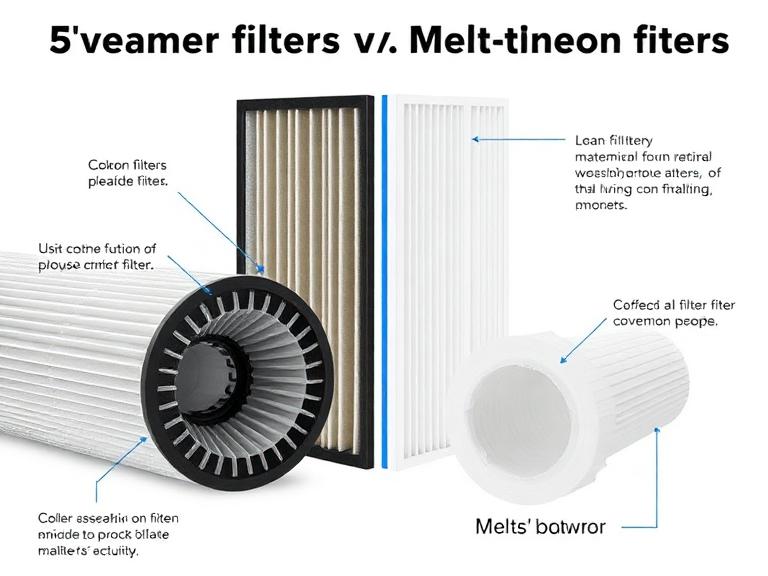
Melt-blown filters, often referred to as spun-bonded filters, are manufactured by extruding molten polymer, typically polypropylene, through microscopic nozzles into a high-velocity air stream. This process creates a continuous web of fine microfibers that are collected on a rotating spindle. The result is a dense, cylindrical matrix of randomly oriented fibers. By manipulating the extrusion parameters, manufacturers create a graded pore structure, where the outer layers have a looser density to capture larger particles, and the inner layers become progressively tighter to trap microscopic contaminants.
Pleated Filter Architecture
Pleated filters are constructed from flat sheets of filtration media, which can be made of cellulose, polyester, glass fiber, or polypropylene. This flat media is folded in an accordion-like fashion (pleated) around a rigid central core and enclosed within an outer cage. The primary goal of the pleated design is to pack the maximum possible surface area into a standard cylindrical footprint. This massive surface area allows the fluid to pass through the media at a lower velocity, reducing the initial differential pressure.
2. Analyzing the Difference Between Pleated and Melt-Blown Filters
The core difference between pleated and melt-blown filters lies in their fundamental approach to particle retention. Engineers must evaluate three critical operational vectors when selecting between these two technologies: flow rate capacity, pressure drop dynamics, and dirt holding capacity.
Flow Rate and Differential Pressure
Because pleated filters offer a significantly larger surface area within the same physical dimensions as a standard cylindrical filter, they naturally accommodate higher flow rates. The fluid encounters less resistance as it distributes across the expansive folded media. Consequently, the initial differential pressure across a pleated filter is generally lower. Conversely, the dense, thick wall of a melt-blown filter creates higher resistance to flow, resulting in a higher initial pressure drop. When high throughput is the primary objective, the difference between pleated and melt-blown filters heavily favors the pleated design.
Dirt Holding Capacity
Dirt holding capacity is a critical metric that dictates how long a filter will operate before requiring replacement. This is where the difference between pleated and melt-blown filters becomes highly nuanced. Pleated filters rely on an expansive surface area to hold dirt. Once the surface is blinded by a layer of particulate cake, the filter restricts flow and must be changed. Melt-blown filters, however, utilize the entire depth of their thick fiber wall to capture particles. Contaminants penetrate the outer layers and become trapped within the complex internal matrix. For fluids with a broad distribution of particle sizes or highly deformable contaminants like gels and colloids, the depth structure of a melt-blown filter often provides a superior dirt holding capacity.
3. Filtration Mechanisms: Surface vs. Depth
The structural analysis above directly correlates to the primary mechanisms of filtration. Understanding these mechanisms is the absolute key to grasping the functional difference between pleated and melt-blown filters.
Pleated filters operate predominantly via surface filtration. As fluid flows perpendicular to the media, particles larger than the pore size are physically blocked and retained on the upstream surface of the pleat. This creates a highly predictable, absolute micron rating, making pleated filters ideal for final polishing and sub-micron sterilization applications.
Melt-blown filters operate via depth filtration. The fluid must navigate a tortuous path through the dense fiber web. Particles are captured not just by direct interception on the surface, but also by inertial impaction, diffusion, and electrostatic attraction deep within the filter wall. We recommend depth filtration for applications involving high loads of suspended solids, as the graded density prevents premature blinding of the filter surface.
4. An Essential Alternative: Wound Wire Filters
While discussing the difference between pleated and melt-blown filters covers a massive portion of the industrial market, no authoritative guide is complete without introducing a third, highly critical depth filtration technology: the yarn wound filter cartridge. In applications with extremely high particulate loads or elevated temperatures, traditional melt-blown media may compress or fail. Yarn wound filters offer unparalleled structural integrity.
As one of China is most experienced filter cartridge equipment suppliers, HENGTENG Machine recognizes the vital role of wound filters in industrial arrays. We developed the PP Yarn Winding Filter Making Machine, a dedicated molding system designed to produce wound wire filter cartridges with unmatched precision and efficiency. The yarn wound filter operates on the same depth filtration principles as a melt-blown filter but utilizes a tightly controlled geometric pattern of twisted yarn to create diamond-shaped passages that trap particulates.
5. Manufacturing Excellence with HENGTENG Machine

For businesses looking to produce high-quality depth filters to complement their filtration portfolios, HENGTENG Machine provides complete turnkey solutions, including equipment design, installation, training, and after-sales support. Our flagship HT Single-Head Wound Wire Filter Machine represents the pinnacle of filter manufacturing technology.
From our experience, consistency is the key to reliable filtration. The key features of our PP Yarn Winding Filter Making Machine include:
- High-Speed Operation: Advanced servo motor control achieves stable, high-speed winding with excellent precision, ensuring your production lines meet demanding schedules.
- Excellent Yarn Forming: Consistent tension control ensures smooth, tightly wound filter cartridges with highly accurate filtration levels, critical for maintaining depth filtration efficiency.
- Automatic Stop Function: The system automatically stops when the yarn line is full or in case of malfunction, ensuring safe operation and drastically reducing material waste.
- Fast Wire Changing: Easy spool replacement and an automatic reset protocol minimize downtime and increase overall factory productivity.
- Energy Efficient Design: Designed for low energy consumption while maintaining high output efficiency, optimizing your operational expenditures.
- Easy to Operate: The machine features a user-friendly interface via a PLC Touch Screen control for rapid parameter adjustment and real-time process monitoring.
The HT Single-Head Wound Wire Filter Machine supports Polypropylene (PP) filter core materials and can produce filter lengths ranging from 10 inches to 40 inches, fully customizable to your client’s needs. Operating on an efficient 3 to 5 kW power supply, it is engineered for fully automatic, continuous 24h operation.
6. Application Guide: When to Use Which Filter
Understanding the difference between pleated and melt-blown filters, as well as yarn wound alternatives, allows engineers to design multi-stage purification arrays. We recommend the following deployment strategies based on specific industrial requirements.
Use Pleated Filters when your primary requirement is high flow rates with a low initial pressure drop, or when an absolute micron rating is mandatory for final product quality. They excel in reverse osmosis (RO) pre-filtration where water is relatively clean, or in the final polishing stages of pharmaceutical and beverage manufacturing.
Use Melt-Blown Filters when the fluid contains a high concentration of deformable particles, gels, or a wide distribution of contaminant sizes. Their depth matrix provides a cost-effective solution for general water treatment, chemical processing, and as a pre-filter to protect expensive pleated downstream elements.
Use Yarn Wound Filters, produced by precision equipment like the HENGTENG PP Yarn Winding Filter Making Machine, when you require extreme structural stability, high dirt holding capacity in heavily contaminated streams, or when operating temperatures exceed the tolerances of standard melt-blown media.
7. Summary Table: Comparing Filter Technologies
To assist procurement managers and facility engineers in making informed decisions, the following table summarizes the operational differences across the three primary filtration technologies.
| Filtration Metric | Pleated Filters | Melt-Blown Filters | Yarn Wound Filters |
|---|---|---|---|
| Primary Mechanism | Surface Filtration | Depth Filtration | Depth / Geometric Filtration |
| Flow Rate Capacity | High | Moderate | Moderate |
| Initial Pressure Drop | Low | Higher | Moderate to High |
| Dirt Holding Capacity | Moderate (Surface Cake) | High (Internal Matrix) | Very High (Structural Depth) |
| Ideal Application | Final polishing, absolute rating | Pre-filtration, gel removal | Heavy particulate loads, harsh environments |
8. Frequently Asked Questions (FAQs)
What is the main difference between pleated and melt-blown filters?
The primary difference between pleated and melt-blown filters is their filtration mechanism. Pleated filters utilize a folded sheet to provide massive surface area for surface filtration, capturing particles on the outside of the media. Melt-blown filters use a thick, dense cylinder of microfibers for depth filtration, trapping particles throughout the wall of the filter.
Can I replace a melt-blown filter with a pleated filter?
It depends heavily on the fluid stream. If the fluid contains a high load of dirt or deformable gels, a pleated filter will blind very quickly on the surface. We recommend analyzing the particulate load; replacing a depth filter with a surface filter in a dirty stream will drastically increase your maintenance frequency.
Why would a manufacturer choose to produce yarn wound filters?
Yarn wound filters offer excellent depth filtration with superior structural rigidity. With advanced equipment like the HENGTENG PP Yarn Winding Filter Making Machine, manufacturers can achieve fully automatic, continuous 24h operation, producing robust filters that excel in heavy industrial applications where standard melt-blown filters might compress or fail.
Are melt-blown filters washable and reusable?
Generally, no. A key difference between pleated and melt-blown filters is cleanability. Because melt-blown filters trap contaminants deep within their internal matrix, they cannot be effectively backwashed or cleaned. They are designed as disposable, high-capacity depth elements.