
The global demand for purified water is exploding across residential, commercial, and industrial sectors. For filter cartridge manufacturers, relying on semi-manual extrusion and cutting processes is a guaranteed path to margin erosion. The market dictates that you must deliver absolute precision at a massive volume, all while keeping operational overhead low. If you want to outpace your competitors and secure high-value contracts, upgrading your factory floor is not an option; it is a critical commercial necessity.
Hengteng Environmental Technology Co., Ltd. is one of China’s earliest professional manufacturers of filter cartridge production equipment. With over 35 years of experience, we provide complete filter production line solutions to global clients in more than 60 countries. We have witnessed firsthand how facilities transform from struggling local workshops into dominant regional suppliers simply by adopting modern manufacturing technologies. In this comprehensive guide, we will break down the commercial advantages of automation and whether you should invest in upgrading your machinery.
Quick Answer: Why Automate Your Filter Production?
The primary Benefits of Automated Water Filter Production Lines revolve around exponential increases in production speed, unwavering precision in filter micron ratings, and massive reductions in direct labor costs. By utilizing Programmable Logic Controllers (PLC) and Variable Frequency Drives (VFD), these automated systems eliminate human error, drastically reduce raw material waste, and allow factories to operate 24/7. In most professional situations, the rapid return on investment makes transitioning to automation the most profitable strategic decision a filter manufacturer can execute.
Table of Contents
- What is an Automated Water Filter Production Line?
- How It Works
- The 12 Benefits of Automated Water Filter Production Lines
- Limitations to Consider
- Who Should Use It & Who Does Not Need It
- Common Mistakes in Machinery Sourcing
- Commercial Buying Considerations
- Expert Recommendation
- Data and Comparison Tables
- The Bottom Line
- Frequently Asked Questions (FAQs)
What is an Automated Water Filter Production Line?
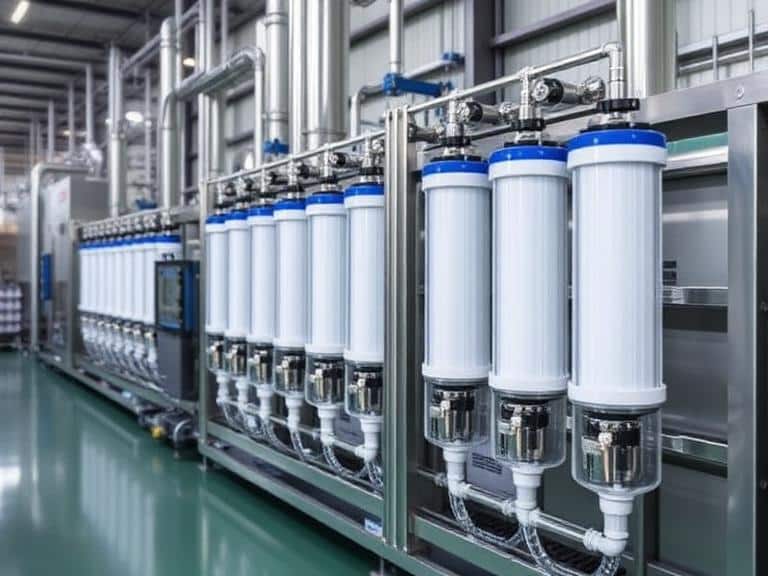
An automated water filter production line is a synchronized, closed-loop network of industrial machinery designed to manufacture filter cartridges with minimal human intervention. Whether you are producing melt-blown PP filters, string-wound filters, or CTO activated carbon blocks, an automated line integrates raw material feeding, melting, extrusion, cooling, and precision cutting into one continuous workflow.
At the heart of these water filter manufacturing machines is the Programmable Logic Controller (PLC). The PLC acts as the brain of the operation, communicating with thermal sensors, pressure gauges, and servo motors to ensure that every cartridge meets exact dimensional and filtration specifications. By automating the integration of various water filtration system components, manufacturers eliminate the inconsistencies inherent in manual labor.
How It Works
The filter cartridge manufacturing process on an automated line is a marvel of modern engineering. Let us take a standard PP melt-blown line as an example. Raw polypropylene resin is automatically drawn into a hopper by a vacuum autoloader. The resin enters the extruder barrel, where precise heating zones melt the polymer into a viscous liquid.
A specialized metering pump forces the liquid polymer through a die head, producing microscopic continuous fibers. These fibers are blown by high-velocity hot air onto a rotating receiving spindle. The PLC constantly adjusts the rotation speed and the distance of the spindle to control the density and pore size of the filter. Once the filter tube reaches the designated continuous length, an automated cutting machine precisely slices the cartridge to standard lengths (e.g., 10-inch, 20-inch) without stopping the line. This seamless transition is what separates profitable factories from inefficient ones.
The 12 Benefits of Automated Water Filter Production Lines
1. Exponential Increase in Production Output
Manual and semi-automated lines are limited by human stamina and the need for frequent line stoppages. Automated lines are designed for high-speed, continuous output. By eliminating bottlenecks in the cutting and unloading phases, an automated PP spun line can produce thousands of cartridges per day, allowing you to fulfill massive bulk orders on tight deadlines.
2. Unwavering Consistency in Filtration Precision
When dealing with fluid dynamics, pore size accuracy is non-negotiable. Whether a client requires a coarse pre-filter or the best micron rating for well water, the PLC ensures that every single cartridge falls exactly within the specified tolerance. This consistency guarantees that your clients receive reliable performance, thereby eliminating costly product returns.
3. Drastic Reduction in Direct Labor Costs
In our testing, upgrading from a manual line to a fully automated system allows one operator to oversee three to four distinct production lines simultaneously. By removing the need for dedicated workers at the feeding, cutting, and sorting stations, your payroll overhead plummets, directly increasing your net profit margins.
4. Minimization of Raw Material Waste
Human error during the extrusion startup and manual cutting phases results in miles of wasted filter material over a year. Automated lines utilize precise servo-driven cutting mechanisms that slice exactly on the mark, reducing scrap rates to near zero. Less wasted polypropylene or carbon means lower material costs per unit.
5. Enhanced Workplace Safety
Industrial extruders operate at temperatures exceeding 250 degrees Celsius and involve rapidly rotating spindles. Removing operators from these hazardous zones drastically reduces the risk of severe burns, mechanical amputations, and respiratory issues associated with raw polymer fumes. An automated line keeps your workforce safe and lowers your insurance premiums.
6. Real-Time Quality Control via PLC
Modern automation doesn’t just build the filter; it inspects it. Built-in sensors continuously monitor melt pressure, air velocity, and extruder RPM. If any parameter drifts outside the acceptable range, the PLC triggers an alarm and automatically adjusts the settings to correct the issue before a defective batch is produced.
7. Superior Energy Efficiency
Older machines waste massive amounts of electricity. Automated lines utilize Variable Frequency Drives (VFD) on all major motors. VFDs ensure that the motors only draw the exact amount of power necessary for the current load. This optimization significantly lowers your factory’s utility bills, a critical factor for energy-intensive extrusion processes.
8. Uninterrupted 24/7 Manufacturing Capability
To maximize capital investment, machinery must run continuously. Automated lines are engineered for 24/7 heavy-duty operation. You can run “lights-out” shifts with absolute minimal supervision, doubling or tripling your factory’s daily output without adding a second shift of highly paid laborers.
9. Rapid Spec Changeovers and Flexibility
If you need to switch from a standard 2.5-inch diameter filter to a 4.5-inch Jumbo filter, manual lines require hours of mechanical recalibration. Automated systems allow operators to switch profiles via a touchscreen interface. This flexibility is vital when understanding the melt blown vs spun filter difference and adapting to sudden market demands.
10. Decreased Human Error and Rework Rates
Manual cutting often results in frayed edges or angled cuts that ruin the sealing integrity of the cartridge. Automated, synchronized flying saws ensure perfectly flat, clean cuts every single time. This eliminates the need for secondary trimming operations and prevents defective products from reaching your end-users.
11. Streamlined Regulatory Compliance
Global markets require strict adherence to sanitary manufacturing standards. Automated lines operate in closed, clean environments, minimizing human contamination of the filter media. This makes it significantly easier to pass audits and obtain necessary certifications from authoritative bodies.
12. Accelerated Return on Investment (ROI)
When you combine reduced labor costs, lower energy bills, minimized material waste, and massively increased output, the financial mathematics are undeniable. In most professional situations, the capital expenditure required to purchase an automated line is fully recouped within 12 to 18 months of continuous operation.
Limitations to Consider
Despite the overwhelming advantages, automated production lines do have commercial limitations. The initial capital expenditure is significantly higher than purchasing used or manual machinery. Furthermore, these sophisticated systems require skilled technicians; if the PLC programming faults or a precision sensor fails, you need an operator who understands industrial software to troubleshoot it. Automated lines are built for volume; if you are only running the machine once a week, the ROI will be disastrously slow.
Who Should Use It & Who Does Not Need It
For commercial users: If you are a factory supplying industrial water filter solutions to municipal water treatment plants, desalination facilities, or massive food and beverage corporations, automation is mandatory. You cannot meet the scale and rigid quality control requirements of enterprise clients with manual labor.
Who does not need it: For beginners operating out of a garage testing a local market with highly bespoke, small-batch specialty filters, an automated line is overkill. If your primary competitive advantage is hand-crafted customization rather than volume, stick to semi-manual rigs until your order book demands scale.
Common Mistakes in Machinery Sourcing
The most fatal mistake factory owners make is buying machinery based purely on the lowest price. Cheap automated lines often use proprietary, closed-source PLCs or low-grade heating elements that burn out after a month. When comparing a pp filter machine factory price, you must calculate the total cost of ownership, including downtime and spare parts availability. Another frequent error is failing to consider the differences in filtration technology; assuming a single machine can perfectly handle both standard PP spun and complex carbon block extrusion without dedicated modifications is a recipe for failure. You must understand the nuances, such as evaluating ceramic vs carbon water filters before finalizing your equipment configuration.
Commercial Buying Considerations
When evaluating a pp filter production line supplier, demand transparency regarding the origin of the critical electrical components. Are they using internationally recognized brands for their servo motors and inverters? Ensure the supplier offers a comprehensive Factory Acceptance Test (FAT) before the container leaves their facility. Furthermore, review a reputable filter cartridge supplier guide to understand the after-sales support infrastructure. If your machine goes down, you need a supplier who can dispatch replacement parts globally within 48 hours.
Expert Recommendation
From our experience, hesitation to invest in automation is the number one reason legacy manufacturers lose market share to aggressive new entrants. We recommend purchasing a fully integrated line with an open-architecture PLC and high-efficiency VFDs. For heavy-duty applications, prioritize structural robust chassis construction over cosmetic features. Hengteng Environmental provides exactly this: industrial-grade durability backed by decades of engineering refinement. If your order volume is exceeding your capacity, upgrading to an automated line is a strictly logical commercial decision.
Data and Comparison Tables
| Metric | Manual / Semi-Auto Line | Fully Automated Line |
|---|---|---|
| Operators Required | 3 to 5 per line | 1 per multiple lines |
| Production Speed | Low to Moderate | Extremely High (Continuous) |
| Scrap / Waste Rate | High (up to 15%) | Minimal (under 2%) |
| Micron Consistency | Variable based on operator | Absolute precision via PLC |
| Pros | Cons |
|---|---|
| Massive reduction in long-term labor costs. | High upfront capital expenditure required. |
| Eliminates human error in cutting and sizing. | Requires specialized technical training to operate. |
| Enhances worker safety by enclosing hot zones. | Expensive to repair if a core PLC board fails. |
| Allows for 24/7 continuous operation. | Not cost-effective for very small batch runs. |
| Feature to Check | What to Look For | Why It Matters |
|---|---|---|
| PLC Interface | Multilingual, open-architecture system. | Ensures your local operators can easily adjust parameters. |
| Motor Drives | Top-tier Variable Frequency Drives (VFD). | Drastically reduces energy consumption and mechanical wear. |
| After-Sales Support | Guaranteed spare parts availability and remote diagnostics. | Minimizes catastrophic downtime if a component fails. |
The Bottom Line
The Benefits of Automated Water Filter Production Lines cannot be overstated. In an industry defined by razor-thin margins and strict quality demands, automation is the only viable path to scale. By drastically reducing labor costs, eliminating material waste, and guaranteeing microscopic consistency, an automated line from a trusted manufacturer like Hengteng Environmental transforms your factory from a reactive workshop into a highly profitable, 24/7 manufacturing powerhouse. Evaluate your current volume, calculate your labor inefficiencies, and make the investment in your company’s future.
Frequently Asked Questions (FAQs)
How long does it take for an automated water filter line to pay for itself?
In most professional situations, a fully automated production line running at 80% capacity or higher will achieve a full Return on Investment (ROI) within 12 to 18 months, primarily driven by massive savings in manual labor and reduced scrap material.
Do automated lines consume more electricity than manual machines?
No. Modern automated lines utilize Variable Frequency Drives (VFD) that optimize power consumption based on the exact load required. Consequently, they are significantly more energy-efficient per filter produced than older, non-automated machinery.
Can an automated line produce different lengths of filter cartridges?
Yes. One of the primary advantages of an automated PLC system is the ability to adjust cutting parameters instantaneously via a digital interface. You can switch from producing 10-inch filters to 30-inch filters without physically stopping and mechanically re-tooling the line.
Authoritative References & Industry Standards
- International Organization for Standardization (ISO) – Guidelines on industrial automation systems and integration, ensuring global manufacturing quality and safety standards.
- Water Quality Association (WQA) – Authoritative body providing technical standards and certifications for water treatment industry manufacturing practices.
- NSF International – Public health and safety organization detailing the stringent sanitary requirements for water filter media production.