
In the highly competitive water and air filtration industry, producing a substandard filter cartridge is a guaranteed path to commercial failure. When your clients rely on your products to protect sensitive reverse osmosis membranes or provide safe drinking water, structural inconsistency is unacceptable. From our experience at HENGTENG Machine, true operational success relies on systematically Improving Melt Blown Filter Quality through precise mechanical and chemical controls, not merely speeding up production lines.
Many manufacturers assume that a basic extrusion setup is sufficient to capture market share. However, in most professional situations, standard, un-optimized manufacturing processes yield filters with severe defects: high initial pressure drops, poor dirt-holding capacity, and catastrophic fiber shedding. These flaws alienate industrial buyers who demand exacting micron ratings. If you want to dominate your local or global market, you must transition from basic manufacturing to precision engineering. This comprehensive guide details the exact parameters, machine upgrades, and operational techniques required for Improving Melt Blown Filter Quality, ensuring your products outperform the competition while maximizing your operational margins.
Quick Answer: The Foundation of Filter Quality
If you are short on time and need immediate actionable advice for Improving Melt Blown Filter Quality, focus entirely on these three critical production vectors. Neglecting these will result in inferior, unsellable filter cartridges.
| Critical Parameter | Optimal Standard | Commercial Impact of Failure |
|---|---|---|
| Polymer Melt Flow Index (MFI) | 1200 to 1500 g/10 min | Low MFI creates thick, brittle fibers that fail to capture fine sediment, ruining your stated micron rating. |
| Die-to-Collector Distance (DCD) | Precisely calibrated per micron requirement | Incorrect distances lead to structural collapse or excessive fluffiness, causing immediate pressure drop failures. |
| Multi-Layer Density Control | 3 distinct density zones (Inner, Middle, Outer) | Single-density filters clog instantly on the outer surface, destroying the product’s lifespan and ROI for the end-user. |
Table of Contents
- What is a Melt Blown Filter and How it Works
- The Commercial Benefits: Why Graded Density Matters
- Limitations and Common Manufacturing Mistakes
- Who Should Manufacture High-Quality Filters
- 12 Expert Tips for Improving Melt Blown Filter Quality
- Buying Considerations: Upgrading Your Equipment
- Expert Recommendation: The 3E3M Solution
- Frequently Asked Questions (FAQ)
- Authoritative References
What is a Melt Blown Filter and How it Works

Before diving into optimization, you must understand the core physics of the machinery. To grasp what is pp spun filter cartridge production, you must look at the non-woven extrusion process. Polypropylene (PP) resin pellets are fed into a heated extruder barrel where they are melted into a highly viscous fluid. This polymer melt is then forced through a precision die head containing hundreds of microscopic spinneret holes.
As the liquid polymer exits the die, it is immediately blasted by high-velocity, high-temperature air streams. This air attenuates (stretches) the polymer into ultra-fine microfibers, often measuring less than a few microns in diameter. These fibers are blown onto a rotating central mandrel or collector screen. Because the fibers are still in a semi-melted state when they land, they thermally bond to one another, creating a rigid, porous, cylindrical depth filter without the need for any chemical adhesives or binders. Improving Melt Blown Filter Quality requires absolute mastery over the temperature, air velocity, and collection speed during this violent, microscopic process.
The Commercial Benefits: Why Graded Density Matters
In our testing, the primary reason buyers seek out premium melt blown filters over standard string-wound or cheap pleated alternatives is their exceptional depth filtration capability. When you focus on Improving Melt Blown Filter Quality, you are engineering a graded density structure. This means the outer layers of the filter are loose and porous to catch large particles like sand and rust, while the inner layers become progressively tighter to capture fine silt and microscopic impurities.
| Production Method | Pros | Cons |
|---|---|---|
| In-House High-Quality Manufacturing | Total quality control, massive profit margin increases, ability to offer custom micron ratings. | Requires significant initial capital expenditure for machinery and operator training. |
| Outsourcing from Third Parties | Zero upfront machine costs, no maintenance overhead. | Vulnerable to supply chain shocks, generic product quality, low profit margins. |
For commercial users providing pre-treatment for heavy-duty industrial reverse osmosis plants, a filter that lacks a true density gradient will surface-blind immediately. Improving Melt Blown Filter Quality ensures that the entire depth of the filter wall is utilized, extending the service life by up to 300% compared to poorly manufactured alternatives.
Limitations and Common Manufacturing Mistakes
The pursuit of Improving Melt Blown Filter Quality is often derailed by common operational mistakes. The most catastrophic error we see among novice manufacturers is utilizing the wrong raw materials. Trying to save money by purchasing low-grade, fractional-melt polypropylene meant for injection molding will destroy your production line. It will clog your spinneret dies, create “shot” (unmelted beads of plastic in the filter), and result in a product that cannot be sold.
Another severe limitation is relying on single-extruder machines to achieve fine micron ratings. You cannot adequately produce best 5 micron water filters 2025 using a basic one-extruder setup, because one extruder cannot independently control the inner, middle, and outer fiber densities required to prevent massive pressure drops. You must upgrade your machinery to overcome this physical limitation.
Who Should Manufacture High-Quality Filters (And Who Does Not Need To)
For commercial users: If you are a large-scale water treatment distributor, an industrial filtration supplier, or an OEM looking to dominate your regional market, investing heavily in Improving Melt Blown Filter Quality is mandatory. Clients running municipal water plants or beverage processing facilities will rigorously test your filters. If they fail, you lose the contract.
Who does not need it: For beginners looking to make a quick profit selling unbranded, low-tier generic filters into unregulated residential markets, you do not need multi-extruder, PLC-controlled precision machines. However, be warned: that low-end market is a race to the bottom with razor-thin margins. To build a sustainable, respected brand, quality is the only viable long-term strategy.
12 Expert Tips for Improving Melt Blown Filter Quality
If you are ready to elevate your manufacturing standards, implement these 12 technical strategies to achieve unparalleled product consistency.
1. Optimize the Polypropylene Melt Flow Index (MFI)
The Melt Flow Index is the lifeblood of the melt blown process. In most professional situations, we recommend sourcing PP resin with an MFI between 1200 and 1500 g/10 min. High MFI indicates low molecular weight and low viscosity when melted. This allows the hot air to easily draw the polymer into micro-fine fibers. Using standard MFI 30 resin will result in thick, coarse fibers that cannot achieve anything below a 50-micron rating.
2. Precision Calibration of Extruder Temperatures
Temperature control is non-negotiable. If your extruder barrel is too cold, the polymer will not fully plasticize, causing blockages and “shot” defects. If the temperature is too high, the PP will thermally degrade, releasing smoke and creating brittle fibers that shed into the water supply. Improving Melt Blown Filter Quality requires mapping distinct temperature zones across the extruder barrel, typically scaling from 180°C at the feed throat up to 260°C at the die head.
3. Regulate Hot Air Velocity and Pressure Dynamics
The high-velocity hot air is what actually forms the fibers. By increasing the air pressure and velocity, you create thinner fibers, which lowers the micron rating of the filter. However, pushing the air velocity too high will snap the fibers in mid-air, creating a dusty, unstable filter environment. You must find the precise aerodynamic balance based on your specific die design.
4. Master the Die-to-Collector Distance (DCD)
The DCD is the physical distance between the tip of the spinneret die and the rotating receiving mandrel. A shorter DCD means the fibers land while still extremely hot, fusing tightly together to create a dense, rigid filter with high structural integrity but higher pressure drop. A longer DCD allows fibers to cool slightly before landing, creating a fluffier, more porous layer. Manipulating the DCD is critical for building a graded density filter.
5. Upgrade to a Multi-Stage Cooling System
Once the fibers hit the mandrel, they must cool at a controlled rate. We recommend implementing variable cooling fans. Proper cooling locks the micro-structure in place without causing thermal shock. The best equipment, like our 3E3M models, offers optional air or water cooling mechanisms depending on the specific environmental demands of your factory.
6. Invest in High-Precision Spinneret Dies
You cannot achieve superior filtration with a poorly machined die head. Improving Melt Blown Filter Quality requires utilizing dies with perfectly uniform hole diameters (often around 0.3mm to 0.4mm). If the holes are uneven, your fibers will be uneven, leading to channeling and bypass within the filter wall. Always source your equipment from top pp filter making machine manufacturers.
7. Maintain Unwavering Polymer Feed Rates
Inconsistent feeding of raw PP pellets into the extruder hopper causes surging in the melt pump. This results in filters with wavy, uneven outer diameters and inconsistent weights. Ensure your auto-loaders are properly calibrated to maintain a constant head pressure within the extruder.
8. Control Ambient Manufacturing Environmental Factors
The microfibers traveling from the die to the collector are incredibly delicate. Drafts from open factory doors, fluctuating ambient temperatures, or high humidity can dramatically alter the fiber trajectory and cooling rates. For heavy-duty applications, enclose your production line in a climate-controlled environment to guarantee year-round consistency.
9. Transition to Fully Automatic PLC Control Systems
Manual knob-turning is obsolete. To truly master Improving Melt Blown Filter Quality, you must upgrade to a pp melt blown filter machine guide compliant PLC system. A digital touch-screen interface combined with frequency converters allows you to adjust screw speeds, mandrel rotation, and carriage movement down to the millimeter, ensuring absolute repeatability across production batches.
10. Engineer a Multi-Layer Graded Density Structure
As mentioned earlier, a single-extruder machine produces a uniform density block. To maximize dirt-holding capacity, you must utilize a machine with multiple extruders (like a 2E2M or 3E3M setup). By assigning one extruder to the inner core (tight), one to the middle layer (medium), and one to the outer layer (loose), you create a true depth filter that captures particles throughout its entire wall thickness.
11. Enforce Strict Routine Die Head Maintenance
Polymer degradation inevitably leaves microscopic carbon deposits inside the spinneret holes. If left uncleaned, these deposits disrupt polymer flow, causing fiber breakage. Implement a strict schedule for removing and ultrasonic-cleaning the die heads. An optimized maintenance protocol is just as vital to Improving Melt Blown Filter Quality as the machinery itself.
12. Continuously Monitor Differential Pressure and Filtration Efficiency
You cannot improve what you do not measure. Establish an in-house testing laboratory to evaluate the initial pressure drop and particle retention efficiency of your output. When assessing cartridge filter materials guide standards, you must prove that your filters meet exact micron specifications. This data allows you to fine-tune your machine parameters in real-time.
Buying Considerations: Upgrading Your Equipment
When assessing a pp spun filter cartridge machine price, commercial users must evaluate the long-term ROI rather than just the initial sticker price. Buying a cheap, single-extruder machine will severely limit your ability to compete in high-margin sectors.
| Machine Feature | Professional Standard Requirement | Why It Matters for Quality |
|---|---|---|
| Extruder Configuration | Minimum 2E2M (2 Extruders, 2 Mandrels), preferably 3E3M. | Crucial for creating precise, multi-layered graded density structures. |
| Control Interface | Fully Automatic PLC with Frequency Inverters. | Eliminates human error, guarantees precise recipe replication and stable winding. |
| Heating Elements | Cast aluminum heaters with high-accuracy thermocouples. | Prevents polymer degradation and ensures a highly stable melt viscosity. |
| Production Speed | 0.6 to 0.8 meters per minute (continuous). | Balances high output volumes with the required cooling time for structural integrity. |
Expert Recommendation: The 3E3M Solution
From our experience, if you are serious about dominating your market and permanently Improving Melt Blown Filter Quality, you must invest in machinery capable of true three-tier density profiling. Single and double extruder setups are fine for basic applications, but for critical industrial filtration, food and beverage processing, or medical-grade pre-treatment, you need the ultimate control provided by a 3E3M architecture.
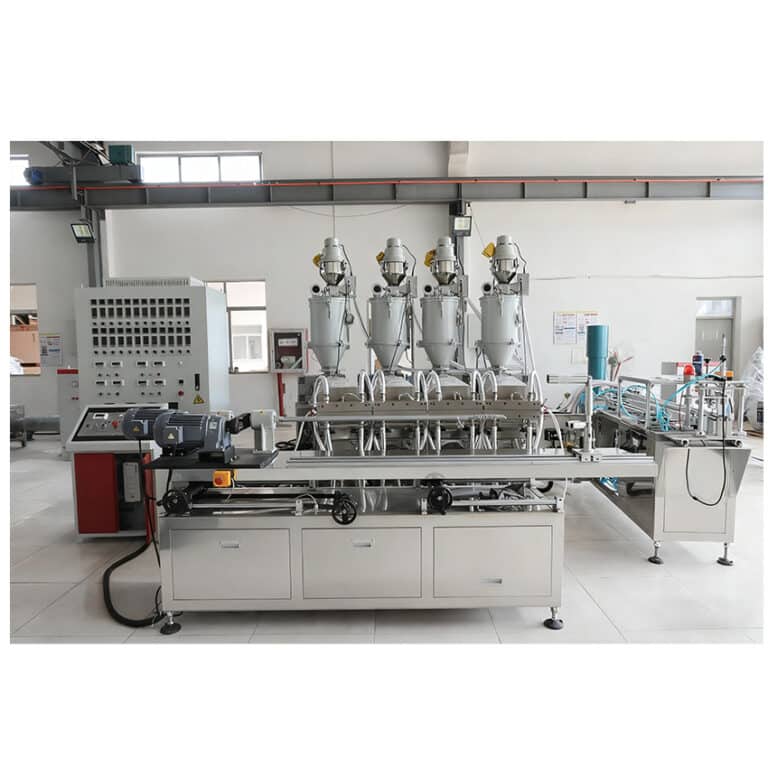
3E3M PP Melt Blown Filter Making Machine by HENGTENG
In our testing, the 3E3M configuration represents the pinnacle of melt blown technology. By utilizing three independent extruders feeding three separate receiving mandrels, this system allows operators to micromanage the inner, middle, and outer layers with absolute precision. This is how you build a world-class filter that offers maximum dirt-holding capacity while maintaining an incredibly low pressure drop.
- Production Speed: 0.6 – 0.8 m/min
- Rated Power: 34 kW/set
- Control System: Fully Automatic PLC + Frequency Converter
- Filter Length Range: 10”– 40” (customizable)
- Material Used: Polypropylene (PP)
- Operation Mode: Continuous 24-hour operation
- Cooling Method: Air cooling or water cooling optional
If you are upgrading your facility, we unequivocally recommend this system. It pays for itself by drastically reducing scrap rates and allowing you to command premium pricing for certified graded-density filters.
Frequently Asked Questions (FAQ)
How does the Melt Flow Index (MFI) affect filter quality?
The MFI determines the viscosity of the melted polymer. A high MFI (1200-1500) allows the hot air streams to draw the polymer into ultra-fine microfibers. These fine fibers are essential for creating tight pore structures required for 1-micron and 5-micron filters. Low MFI results in thick fibers and poor filtration efficiency.
Why is a multi-layer graded density structure important?
A graded density structure ensures that the filter captures large particles on the outside and progressively finer particles toward the core. Without this structure, the outer layer would immediately blind and clog, severely restricting water flow and drastically reducing the lifespan of the filter cartridge.
Can I run my melt blown machine 24/7?
Yes, in most professional situations, commercial-grade machinery like the HENGTENG 3E3M is designed for continuous 24-hour operation. However, achieving this requires strict adherence to raw material quality standards and routine die head cleaning to prevent polymer degradation and blockages over extended runs.
Authoritative References
To ensure your manufacturing processes align with global quality and safety benchmarks, we recommend consulting the material testing frameworks established by the following authoritative organizations:
- ASTM International – Provides the definitive standard test methods for measuring the Melt Flow Rate (MFR) and Melt Flow Index (MFI) of thermoplastics, crucial for optimizing your raw PP resin selection.
- U.S. Food and Drug Administration (FDA) – Establishes the Title 21 CFR compliance standards required for polypropylene materials intended to come into contact with food and potable drinking water.
- Water Quality Association (WQA) – Offers comprehensive certification and performance testing protocols for water filtration components, ensuring your filters meet the rigorous demands of municipal and industrial clients.