
In the industrial water filtration sector, the difference between a high-performance filter cartridge and a useless piece of plastic comes down to machine calibration. Many new manufacturers enter the market believing that simply loading polypropylene resin into an extruder will yield a marketable product. From our experience, this is a fast track to producing filters with inconsistent micron ratings, poor dirt-holding capacity, and high pressure drops.
To dominate this competitive market, you must possess a rigorous understanding of the Parameters in PP Melt Blown Filter manufacturing. HENGTENG Machine, established in 1989, stands as a premier manufacturer of filter cartridge making machines in China. Specializing in PP melt blown, CTO carbon block, and other filter machines, we utilize advanced design and manufacturing processes. Our commitment to quality is reflected in our ISO9001 and CE certifications and our efficient support system, ensuring our clients receive exceptional service from production to installation. In this guide, we are pulling back the curtain to explain exactly how to control your production line for maximum profitability and quality.
Quick Answer: What Are the Key Parameters in PP Melt Blown Filter Production?
The defining Parameters in PP Melt Blown Filter manufacturing are the precise variables that dictate fiber diameter, filter density, and micron rating. The eight core parameters are: 1) Extrusion Temperature, 2) Melt Pump Speed, 3) Hot Air Temperature, 4) Hot Air Pressure, 5) Die-to-Collector Distance (DCD), 6) Collector Speed, 7) Polymer Melt Flow Index (MFI), and 8) Cooling Suction Volume. Adjusting these parameters incorrectly leads to brittle fibers, poor filtration efficiency, and structural collapse under pressure. We recommend investing in machinery that offers automated PLC touch-screen controls to manage these parameters simultaneously, eliminating human error from the production floor.
Table of Contents
- What is the PP Melt Blown Process?
- How It Works: The Physics of Fiber Formation
- The 8 Critical Parameters in PP Melt Blown Filter Production
- Quick Summary Table: Parameter Impacts
- Commercial Benefits of Mastering These Parameters
- Limitations of the Melt Blown Process
- Who Should Manufacture These Filters?
- Comparison Table: Melt Blown vs. String Wound vs. CTO
- Common Production Mistakes
- Buying Considerations for Equipment
- Pros and Cons of Automated Production
- Expert Recommendation
- Frequently Asked Questions (FAQ)
- Authoritative References
What is the PP Melt Blown Process?
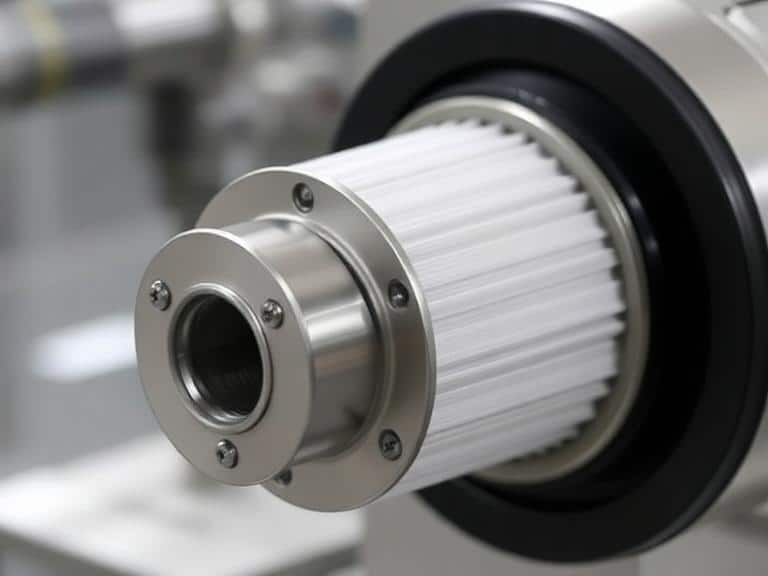
Before analyzing the specific Parameters in PP Melt Blown Filter production, we must define the technology. Melt blowing is a micro-fiber nonwoven extrusion process. Polypropylene (PP) polymer resin is melted and extruded through tiny nozzles in a specialized die head. As the polymer exits the die, high-velocity hot air stretches and attenuates the polymer streams into microscopic fibers. These fibers are blown onto a rotating mandrel (collector), where they cool and self-bond to form a cylindrical depth filter.
Because the fibers bond together without the use of binders, resins, or lubricants, the resulting cartridge is 100% pure polypropylene, making it FDA-compliant and chemically resistant. To understand how this fits into the broader industry, you can explore the filter cartridge manufacturing process in our comprehensive guides.
How It Works: The Physics of Fiber Formation
The creation of a depth filter relies on creating a gradient structure. The outer layers of the filter must have looser, thicker fibers to trap large particles (like sand and rust), while the inner layers must have tight, microscopic fibers to trap fine particles down to 1 micron or less. Achieving this gradient structure is impossible without meticulously adjusting the Parameters in PP Melt Blown Filter manufacturing on the fly during the extrusion process.
The 8 Critical Parameters in PP Melt Blown Filter Production
From our experience engineering advanced production lines, these are the exact metrics your operators must monitor and control to produce commercial-grade filters.
1. Extrusion Temperature
The temperature zones along the extruder screw and the die head dictate the viscosity of the melted polypropylene. If the temperature is too low, the polymer is too thick, leading to high die pressure, equipment damage, and thick, rigid fibers. If the temperature is too high, the polymer degrades, causing “shot” (un-stretched droplets of plastic) to embed in the filter, destroying its structural integrity. Ideal temperatures typically range between 230°C and 280°C depending on the resin.
2. Melt Pump Speed (Polymer Throughput)
The melt pump controls exactly how much liquid polymer is pushed through the die nozzles per minute. Increasing the melt pump speed increases the weight and thickness of the resulting fibers. To create a 1-micron filter, the melt pump speed must be kept relatively low to allow the hot air to attenuate the fibers to a microscopic diameter. High throughput is reserved for the outer, coarser layers of the filter.
3. Hot Air Temperature
The air that drafts the polymer must be hotter than the polymer itself, typically set 10°C to 20°C above the die temperature. If the air is too cold, the fibers cool too quickly and do not stretch properly, resulting in a coarse, ineffective filter. Proper air temperature ensures the fibers remain in a semi-molten state long enough to be drawn into ultra-fine filaments.
4. Hot Air Pressure and Velocity
This is arguably the most critical of the Parameters in PP Melt Blown Filter production. High air pressure creates aggressive drafting, pulling the polymer into incredibly fine fibers (essential for 1-micron or 5-micron ratings). Low air pressure produces thicker fibers suitable for 50-micron ratings. In our testing, fluctuations in air pressure from cheap compressors are the number one cause of inconsistent micron ratings.
5. Die-to-Collector Distance (DCD)
This refers to the physical gap between the extrusion die and the rotating receiving mandrel. A short DCD means the fibers hit the mandrel while still highly molten, creating a dense, hard filter with low porosity. A longer DCD allows the fibers to cool slightly in the air, creating a fluffier, softer filter with high dirt-holding capacity. Operators must adjust the DCD to achieve the desired filter weight and compression strength.
6. Collector Speed (Mandrel Rotation and Translation)
The speed at which the receiving mandrel rotates and moves horizontally determines the outer diameter (OD) and the structural pattern of the filter. Faster rotation distributes the fibers more thinly, while slower rotation builds bulk quickly. Proper synchronization between the collector speed and polymer throughput is what guarantees a perfectly cylindrical cartridge.
7. Polymer Melt Flow Index (MFI)
While not a machine setting, the raw material parameter is non-negotiable. You cannot use generic injection-molding polypropylene. Melt blown production requires a specific high-MFI resin (typically between 1000 and 1500 g/10min). A low MFI resin will not stretch into fine fibers and will quickly clog your die spinnerets.
8. Cooling Suction / Vacuum Volume
Underneath the rotating mandrel, an exhaust fan pulls a vacuum. This suction pulls the hot, fly-away fibers tightly onto the mandrel and helps extract excess heat. Insufficient suction results in a “fuzzy” filter surface and poor layer bonding, while excessive suction can compress the filter too tightly, ruining its porosity.
Quick Summary Table: Parameter Impacts
| Parameter | If Set Too High | If Set Too Low | Impact on Filter |
|---|---|---|---|
| Extrusion Temp | Polymer degrades; “Shot” formation | High pressure; thick fibers | Fiber quality & strength |
| Air Pressure | Fibers break into dust; high energy cost | Thick, coarse fibers; poor micron rating | Micron rating (Filtration precision) |
| DCD (Distance) | Soft, fluffy, easily crushed filter | Hard, dense, low-capacity filter | Density & Dirt-holding capacity |
| Collector Speed | Thin filter; low weight | Oversized filter; out of spec OD | Dimensional accuracy |
Commercial Benefits of Mastering These Parameters
Why should you care about the minutiae of these Parameters in PP Melt Blown Filter production? Because control equals profitability. When you master these settings, you can produce highly sought-after gradient density filters. These filters last three times longer than uniform-density filters because they trap particles throughout the entire depth of the wall, rather than just blinding over on the surface.
Furthermore, precise parameter control minimizes material waste. A well-calibrated machine utilizes 99% of the extruded resin, drastically lowering your cost of goods sold. If you want to supply top-tier clients, you must compete with the industrial filter cartridge manufacturers, which is only possible with stringent quality control.
Limitations of the Melt Blown Process
We are industry practitioners, and we must be honest about limitations. If the Parameters in PP Melt Blown Filter manufacturing are not strictly monitored, the scrap rate is catastrophic. If your heater bands fail or your air pressure drops for even 10 seconds, the entire batch of filters on the mandrel is ruined. Furthermore, the process is highly energy-intensive. Heating the compressed air accounts for massive electrical consumption, meaning you must operate the machine continuously to achieve a good ROI; stopping and starting the machine wastes immense amounts of energy and raw material.
Who Should Manufacture These Filters? & Who Does Not Need To
For commercial users: Water treatment companies, desalination plants, and regional distributors spending more than $50,000 annually importing filter cartridges should absolutely bring production in-house. By utilizing a pp melt blown filter making machine, you can cut your unit costs by up to 60% and control your own supply chain.
Who does not need it: For beginners or small residential plumbers selling only a few boxes of filters a month, buying an entire production line is commercial suicide. Stick to wholesale purchasing until your volume justifies a heavy machinery investment. If your interest is purely survivalist, you might be better served learning how to build your own water filter using basic materials.
Comparison Table: Melt Blown vs. String Wound vs. CTO Carbon
| Feature | PP Melt Blown Filters | String Wound Filters | CTO Carbon Block Filters |
|---|---|---|---|
| Primary Function | High-efficiency sediment removal | High dirt-holding for coarse sediment | Chlorine, odor, and VOC removal |
| Manufacturing Process | Polymer extrusion & air drafting | Yarn spinning & winding | Carbon extrusion & sintering |
| Parameter Sensitivity | Extremely High (Temperature & Air) | Low (Tension based) | Moderate (Binder ratio & Heat) |
| Machine Required | Melt Blown Extruder | PP yarn making machine | cto carbon block filter machine |
Common Mistakes in Production
In most professional situations, we see new operators make the exact same errors when adjusting the Parameters in PP Melt Blown Filter equipment:
- Chasing Speed over Quality: Increasing the melt pump speed to produce filters faster without proportionately increasing the hot air pressure. The result is a filter that looks fine but has a 20-micron rating instead of the advertised 1-micron rating.
- Ignoring Ambient Conditions: Failing to realize that a cold, humid factory floor affects the cooling rate of the fibers. You must adjust your DCD and suction depending on the ambient temperature.
- Using Low-Grade Resin: Trying to save pennies by buying low-MFI or recycled polypropylene. This causes immediate die clogging. You will spend more money paying operators to clean the die head than you saved on the cheap resin.
Buying Considerations for Melt Blown Machinery
When you are ready to invest, you must evaluate the machinery based on its ability to control the Parameters in PP Melt Blown Filter production automatically.
| Component | What to Look For | Why It Matters |
|---|---|---|
| Control System | Siemens or Omron PLC Touch Screen | Allows operators to save “recipes” for different micron ratings, ensuring perfect repeatability. |
| Air Heating Tank | High-efficiency insulated stainless steel | Air temperature stability is paramount. Poor insulation causes temperature drops and ruined fibers. |
| Die Head Quality | Precision-drilled spinnerets (Japanese or German tooling) | Rough nozzles create turbulent polymer flow, resulting in inconsistent fiber diameters. |
| Manufacturer Support | On-site installation and parameter training | Without a pp filter production line supplier who teaches you the parameters, the machine is useless. |
Pros and Cons of Automated Production
| Pros of In-House Melt Blown Production | Cons of In-House Melt Blown Production |
|---|---|
| Massive reduction in cost per cartridge. | High initial capital expenditure for the machinery. |
| Absolute control over filter quality and micron ratings. | Requires continuous 24/7 operation to be energy efficient. |
| Ability to fulfill large custom orders instantly. | Requires skilled operators who understand extrusion thermodynamics. |
| Eliminates reliance on overseas shipping and import delays. | Requires significant factory floor space and high electrical capacity. |
Expert Recommendation
From our experience at HENGTENG Machine: You cannot fake quality in water filtration. If your filters fail to hold back particulate matter, your clients will experience catastrophic failures in their reverse osmosis membranes or industrial processing equipment. The only way to guarantee filter efficacy is by mastering the Parameters in PP Melt Blown Filter production.
We recommend upgrading your facility with the HENGTENG 3E3M PP Melt Blown Filter Making Machine. It is designed specifically to automate the complex interplay between extrusion temperature, air pressure, and collector speed. By removing the guesswork from the process, our machinery ensures that whether you are running a 1-micron or a 50-micron batch, your gradient density remains flawless. If you want to build a reputation as a top-tier supplier, investing in intelligent, CE-certified machinery from a manufacturer with over three decades of experience is unequivocally worth it.
Frequently Asked Questions (FAQ)
How do you control the micron rating in a PP melt blown filter?
The micron rating is controlled by adjusting the Parameters in PP Melt Blown Filter production, primarily the hot air pressure and melt pump speed. Higher air pressure and lower polymer throughput create ultra-fine fibers that yield a lower (tighter) micron rating, such as 1-micron. Lower air pressure creates thicker fibers for 10 or 50-micron ratings.
What is the ideal temperature for PP melt blown extrusion?
While it depends on the specific MFI of the polypropylene resin used, standard extrusion temperatures typically range from 230°C to 280°C across the heating zones. The drafting air temperature is usually kept 10°C to 20°C hotter than the die temperature to ensure proper fiber attenuation without degrading the polymer.
Why is my melt blown filter producing a fuzzy or shedding surface?
A shedding or fuzzy surface is usually the result of an incorrect Die-to-Collector Distance (DCD) or insufficient vacuum suction underneath the mandrel. If the fibers cool too much before hitting the mandrel, they will not thermally bond to the underlying layers, resulting in loose fibers that shed into the water stream. Adjusting these parameters will yield a smooth, bonded surface.
Authoritative References
To ensure your manufacturing protocols align with global industrial and safety standards, we recommend reviewing the following authoritative sources:
- ASTM International: ASTM D6908-03 – Standard Practice for Integrity Testing of Water Filtration Membranes and Filter Cartridges, ensuring your parameter adjustments meet structural integrity tests.
- International Organization for Standardization (ISO): ISO 9001:2015 – Quality management systems that heavily emphasize parameter control, calibration, and consistency in manufacturing environments.
- Water Quality Association (WQA): WQA Professional Certification – Guidelines on the performance requirements and testing protocols for depth filters used in residential and commercial water treatment.