
Navigating the industrial filtration manufacturing landscape requires a ruthless evaluation of production mechanics. Producing a standard polypropylene (PP) melt-blown filter might seem simple to a novice, but achieving exact, repeatable micron ratings across a gradient density structure is an advanced engineering discipline. In the realm of melt-blown technology, the 2E2M configuration (Two Extruders, Two Moulds) has become the commercial standard for creating high-capacity, dual-layer gradient depth filters. However, owning the machinery is only half the battle. If you do not understand the thermodynamic and kinetic variables at play, your production line will churn out inconsistent, easily blinded filter blocks that fail in the field.
From our experience, the factors Affecting 2E2M Filter Cartridge Performance encompass both raw material properties and machine calibration metrics. The most critical variables include the Melt Flow Index (MFI) of the polypropylene resin, the extrusion barrel temperature, hot air attenuation velocity, and the Die-to-Collector Distance (DCD). Mastering these elements allows operators to dictate fiber diameter and porosity, ultimately determining the dirt-holding capacity, pressure drop, and absolute micron rating of the finished filter cartridge.
Quick Answer: What Drives 2E2M Filter Quality?
- Thermal Calibration: Extrusion temperature dictates polymer viscosity. Too cold, and the machine jams; too hot, and the fibers become brittle, leading to shedding.
- Air Attenuation: High-pressure hot air stretches the molten polymer into microfibers. Higher air pressure creates finer fibers (lower micron rating).
- Gradient Control: The 2E2M setup uses two extruders to create a coarse outer layer for large particulate capture and a dense inner layer for fine filtration. The ratio between these extruders dictates overall lifespan.
- Raw Material: You must use virgin PP resin with a specific Melt Flow Index (typically 1200 to 1500 g/10min) for high-efficiency water filtration.
Table of Contents
- What is a 2E2M Filter Cartridge?
- How the 2E2M Process Works
- 12 Factors Affecting 2E2M Filter Cartridge Performance
- Benefits of 2E2M Manufacturing
- Limitations of the Process
- Who Should Use It & Who Doesn’t Need It
- Common Mistakes in Production
- Buying Considerations
- Expert Recommendation & Featured Equipment
- Pros/Cons and Comparison Tables
- Frequently Asked Questions
- Authoritative References
What is a 2E2M Filter Cartridge?
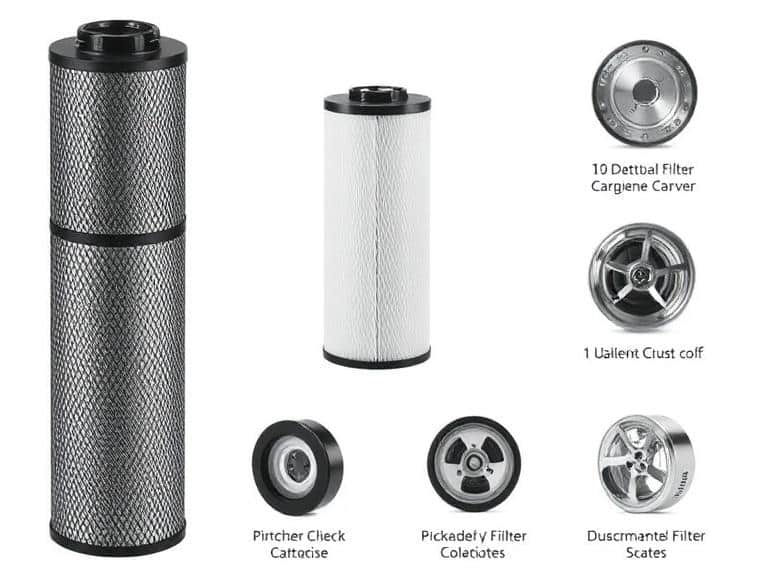
Before diagnosing the variables Affecting 2E2M Filter Cartridge Performance, we must define the architecture. “2E2M” refers to a production line equipped with two independent extruders and two melt-blown dies (moulds). This setup produces a dual-layer PP spun filter cartridge. The fundamental goal of this configuration is to create a true gradient density profile. If you are wondering what is pp spun filter cartridge engineering at its core, it is the deliberate manipulation of fiber thickness to catch different sized particles at different depths of the filter wall.
How the 2E2M Process Works
The manufacturing process begins by feeding raw polypropylene pellets into the two extruders. Inside the heated barrels, rotating screws melt and push the polymer toward the die heads. As the molten polymer exits the microscopic holes of the die, high-velocity hot air stretches (attenuates) the polymer into continuous, ultra-fine microfibers. These fibers are blown onto a rotating receiving mandrel.
Because there are two extruders, you can set the first extruder to produce very fine, densely packed fibers (forming the inner core, e.g., 1-micron filtration) and the second extruder to produce thicker, loosely packed fibers (forming the outer shell, e.g., 5-micron filtration). This dual-layer approach prevents premature blinding, as larger particles are trapped on the outside while fine particles penetrate to the core.
12 Factors Affecting 2E2M Filter Cartridge Performance
1. Melt Flow Index (MFI) of the Polypropylene Resin
In most professional situations, the raw material is the hardest variable to fake. The MFI dictates how easily the melted plastic flows. For high-quality water filtration, you need a resin with a high MFI (typically 1200-1500 g/10min). A lower MFI produces thick, rigid fibers suitable only for coarse filtration, while an MFI that is too high results in “shot” (unattenuated polymer droplets that ruin filter porosity).
2. Extrusion Barrel Temperature Profile
Temperature must be staged sequentially across the extruder barrel. If the feed zone is too hot, premature melting causes bridging and inconsistent feed rates. If the die tip is too cold, the polymer viscosity increases, leading to die blockage and inconsistent fiber diameters, severely Affecting 2E2M Filter Cartridge Performance and lowering its dirt-holding capacity.
3. Hot Air Velocity and Pressure
This is the driving force of the melt-blown process. The hot air stretches the polymer into microfibers. Higher air pressure creates finer fibers, which drastically lowers the micron rating of the filter. However, excessive air pressure causes fiber breakage and “fly,” leading to weak cartridge structural integrity.
4. Die-to-Collector Distance (DCD)
The distance between the die tip and the rotating mandrel is paramount. If the DCD is too short, the fibers arrive still molten, fusing into a solid, non-porous plastic block. If the DCD is too long, the fibers cool too much in transit and fail to bond with one another, resulting in a fluffy, weak cartridge that collapses under water pressure.
5. Mandrel Rotational Speed and Winding Tension
The speed at which the receiving mandrel rotates dictates the density and thickness of the filter layers. A faster rotation spreads the fibers thinner, increasing porosity. Synchronizing the RPM of the mandrel with the output rate of the extruders is how top industrial filter cartridge manufacturers guarantee exact outer dimensions (OD).
6. Hot Air Temperature
The temperature of the attenuating air must be closely matched to the polymer melt temperature. If the air is too cold, it rapidly quenches the fibers before they can stretch, resulting in coarse, thick strands. Standard operational parameters usually dictate air temperatures between 250°C and 280°C.
7. Die Hole Geometry and Maintenance
The spinneret (die) contains hundreds of microscopic holes. Any carbonized polymer buildup in these holes will cause fiber deflection or blockage. Regular ultrasonic cleaning of the dies is mandatory. A partially blocked die creates uneven density patches in the cartridge, causing channeling where water bypasses the filtration media entirely.
8. Extruder Output Ratio (Inner vs. Outer Layer)
The defining feature of a 2E2M machine is the ratio of output between the two extruders. If the inner 1-micron layer is too thick and the outer 5-micron layer is too thin, the filter will clog rapidly on the surface. We recommend configuring the output to create a 30% inner core and a 70% outer pre-filtration zone for optimal lifespan.
9. Cooling Water Temperature and Ambient Humidity
Ambient factory conditions play a massive role in cooling the fibers as they travel the DCD. High ambient humidity can cause microscopic steam pockets within the polymer web, weakening the fibers. Furthermore, the cooling water used to chill the extruder feed throat must be strictly regulated to prevent hopper bridging.
10. Screw RPM and Feed Rate
The rotation speed of the extruder screw dictates the volume of polymer pushed through the die. An inconsistent feed rate leads to pulsating output, creating weak bands or heavy rings on the finished cartridge. High-precision gear pumps are often utilized to ensure a perfectly smooth volumetric flow.
11. Fiber Entanglement (Porosity Control)
A high-performance filter requires a chaotic, highly entangled fiber web to trap dirt mechanically. This is achieved by carefully balancing the air angle and velocity. Poor entanglement results in straight, parallel fibers that simply allow elongated particles to slip right through the filter matrix.
12. Post-Extrusion Curing and Cutting
Once the continuous tube of filter media is formed, it must cool uniformly before being cut into 10″, 20″, 30″, or 40″ lengths. If the cutting mechanism applies too much pressure while the core is still warm, the ends of the filter will deform, preventing a proper seal when installed in a standard filter housing.
Benefits of 2E2M Manufacturing
Why upgrade from a single-extruder machine to a 2E2M setup? The commercial reality is that dual-layer gradient filters sell for a premium and perform exponentially better. By utilizing two distinct melt-blown streams, the cartridge achieves depth filtration—trapping large sand and rust particles on the outside, while saving the dense inner core for fine silt and microscopic impurities. This effectively doubles the lifespan of the filter compared to a uniform single-layer cartridge.
Limitations of the Process
We must use practical commercial judgment: melt-blown filters are not the solution for everything. They are strictly designed for sediment and particulate removal. They will not remove chlorine, VOCs, or heavy metals. For chemical adsorption, you must transition your line to utilize a cto carbon block filter machine. Additionally, melt-blown PP has temperature limitations and should not be used for liquid streams exceeding 80°C.
Who Should Use It & Who Doesn’t Need It
For commercial users: Water treatment plants, desalination pre-treatment facilities, and food & beverage manufacturers absolutely must rely on gradient density 2E2M filters to protect expensive downstream RO membranes.
For heavy-duty applications: Industrial chemical processing often requires high-capacity depth filters. The 2E2M output provides the structural integrity needed to withstand high differential pressure without collapsing.
Who does not need it: If you are filtering extremely high-solids fluid like raw sewage, a standard melt-blown filter will blind immediately. In these scenarios, analyzing are pleated sediment filters better will lead you to choose a washable, high-surface-area pleated design instead.
Common Mistakes in Production
In our testing, the most catastrophic mistake operators make is attempting to increase production speed by cranking up the extruder RPM and temperature simultaneously without adjusting the air attenuation. This results in thick, glossy filters that look beautiful but possess zero porosity. They act as water stops, not water filters. Another critical error is ignoring the difference between CTO and UDF filters when advising clients on system layouts, leading to misplaced sediment filters downstream of carbon blocks.
Buying Considerations
When investing in a pp melt blown filter cartridge machine, you must evaluate the PLC control system. Older, manual-relay machines make it impossible to track and repeat successful production recipes. Demand a touch-screen PLC interface that allows you to save exact temperature profiles, RPMs, and air pressures. Furthermore, verify that the machine utilizes high-quality inverter drives to prevent power surges from altering your extrusion consistency.
Expert Recommendation & Featured Equipment
Is it actually worth upgrading your production line to a 2E2M configuration? Absolutely. The market for generic, single-layer filters is a race to the bottom on price. By controlling the variables Affecting 2E2M Filter Cartridge Performance, you can produce premium, highly profitable gradient filters that commercial clients demand.
We recommend partnering with HENGTENG Machine. Their equipment is engineered for stability, offering precise thermal controls and advanced die-head metallurgy that prevents carbonization buildup, allowing for 24/7 continuous operation.

HENGTENG Machine 2e2mPP Melt-blown Filter Cartridge Machine
Engineered for high-efficiency dual-layer gradient depth filtration manufacturing.
- Power Consumption: 30KW/h
- Filter Precision: 1μm, 5μm, 10μm, 20μm, 30μm, 50μm, … 100μm
- Inner Diameter Range: 10mm – 150mm (Default 28mm)
- Outer Diameter Range: 38mm – 120mm (when ID = 28mm)
- Filter Lengths: 10″, 20″, 30″, 40″
- Voltage: AC380V/Hz, DC220V/50Hz (Customizable)
Summary and Comparison Tables
| Pros | Cons |
|---|---|
| Creates true gradient depth filtration, doubling dirt-holding capacity. | Higher initial capital expenditure for the machine compared to 1E1M. |
| Allows precise control over dual micron ratings (e.g., 5-micron outer, 1-micron inner). | Requires a highly trained operator to balance two extruders simultaneously. |
| Commands higher retail and wholesale pricing in the market. | Consumes slightly more floor space and electrical power (30KW/h). |
| Superior structural rigidity prevents collapse under high pressure. | Increased downtime during material color or MFI changeovers. |
| Configuration | Layer Count | Gradient Control | Best Application |
|---|---|---|---|
| 1E1M (1 Extruder) | Single Layer | Poor (Uniform density) | Basic residential pre-filtration, low-budget markets. |
| 2E2M (2 Extruders) | Dual Layer | Excellent (Distinct coarse and fine zones) | Commercial RO pre-treatment, standard industrial use. |
| 3E3M (3 Extruders) | Triple Layer | Absolute (Coarse, medium, ultra-fine zones) | High-end industrial, pharmaceutical, and high-purity microelectronics. |
Frequently Asked Questions (FAQ)
What is the ideal MFI for PP melt-blown filter manufacturing?
In most professional situations, the ideal Melt Flow Index (MFI) for water filter cartridges ranges from 1200 to 1500 g/10min. Using a resin with a lower MFI will result in overly thick fibers that cannot achieve a 1-micron or 5-micron absolute rating.
Why are my melt-blown filters collapsing under water pressure?
Filter collapse is generally caused by an excessive Die-to-Collector Distance (DCD) or a low extrusion temperature. If the polymer cools too rapidly before hitting the receiving mandrel, the fibers fail to thermally bond together, resulting in a weak, spongy structure that crushes easily under hydraulic pressure.
How do I decrease the micron rating on a 2E2M machine?
To achieve a finer (lower) micron rating, you must increase the hot air attenuation pressure while slightly decreasing the polymer output from the extruder. This combination forces the polymer into much thinner, finer microfibers, resulting in a tighter filtration matrix.
Authoritative References & Industry Standards
To deepen your understanding of the variables Affecting 2E2M Filter Cartridge Performance and nonwoven manufacturing standards, we recommend consulting the following organizations:
- ASTM International – Provides standardized testing methodologies for evaluating the porosity, pressure drop, and dirt-holding capacity of nonwoven filter media.
- Water Quality Association (WQA) – The leading authoritative body on residential and commercial water treatment standards and product certifications.
- INDA (Association of the Nonwoven Fabrics Industry) – Offers comprehensive technical guidelines, research, and symposiums dedicated exclusively to melt-blown and spunbond manufacturing technologies.