
Operating a polypropylene (PP) spun filter production line without a rigorous understanding of extrusion thermodynamics is a fast track to destroying your operational profit margins. In the highly competitive fluid filtration industry, end-users judge your brand entirely by performance metrics: micron precision, pressure drop, and structural integrity. From our experience auditing manufacturing facilities worldwide, production managers routinely misdiagnose Melt Blown Filter Defects, adjusting the wrong machinery parameters and subsequently generating thousands of dollars in wasted raw polymer material.
In most professional situations, a filter cartridge failing to meet its exact specification is not a result of bad raw materials, but a fundamental misalignment in the melt blown machinery’s temperature, air velocity, or collection distance. We recommend tackling these issues systematically. In this authoritative engineering guide, we dissect the nine most critical Melt Blown Filter Defects, explaining exactly why they occur on a molecular level, and providing definitive, commercial-grade fixes to optimize your extrusion hardware.
Quick Answer: The 9 Core Melt Blown Filter Defects and Primary Fixes
To immediately restore your production quality, identify the physical symptom and apply these primary machine adjustments:
- Shot (Polymer Blobs): Decrease extruder temperature or increase hot air velocity.
- Fly (Loose Linting Fibers): Decrease hot air temperature or reduce air volume.
- Roping (Thick Fiber Bundles): Increase Die-to-Collector Distance (DCD) or increase air velocity.
- Uneven Web Density: Clean the spinneret die holes and ensure uniform air knife pressure.
- High Pressure Drop: Increase fiber diameter by lowering air velocity or raising polymer throughput.
- Poor Filtration Efficiency: Decrease fiber diameter by raising air temperature or lowering polymer throughput.
- Brittleness: Decrease extrusion temperature to prevent thermal degradation of the polymer.
- Burn Marks (Discoloration): Purge the extruder barrel to remove carbonized material and lower die temperatures.
- Core Collapse: Increase the structural integrity by lowering the DCD or increasing the inner layer density.
If these parameter adjustments fail, the root cause lies within outdated or malfunctioning equipment. In such cases, upgrading to modern water filter manufacturing machines featuring automated PLC controls is the most cost-effective long-term solution.
Table of Contents
- What Are Melt Blown Filter Defects?
- How the Melt Blown Process Fails
- The 9 Common Melt Blown Filter Defects and Fixes
- Benefits of Eliminating Manufacturing Defects
- Limitations of Standard Troubleshooting
- Who Should Upgrade Their Machinery
- Common Mistakes in Defect Resolution
- Comparison Table: Filter Types & Defect Susceptibility
- Pros and Cons Table: High-Speed Production vs. Quality Control
- Buying Guide Table: Machine Specifications
- Expert Recommendation
- Frequently Asked Questions (FAQ)
- Authoritative References
What Are Melt Blown Filter Defects?
Melt Blown Filter Defects are physical or structural anomalies that occur during the extrusion and collection phases of polypropylene spun cartridge manufacturing. A perfect melt blown filter consists of continuous, microscopic thermoplastic fibers entangled to form a gradient density web. This web must simultaneously trap particulate matter while allowing fluid to pass with minimal resistance.
When reviewing the cartridge filter materials guide, PP is preferred for its chemical resistance and thermal stability. However, when the delicate balance of polymer melt viscosity, hot air attenuation, and cooling distances is disrupted, the resulting filter web becomes compromised. These defects manifest as visual deformities (blobs, discoloration) or invisible performance failures (failed micron ratings, immediate pressure clogging).
How the Melt Blown Process Fails
Understanding the failure requires understanding the mechanics. The melt blown process involves forcing molten polymer through microscopic holes in a spinneret die. Simultaneously, high-velocity, high-temperature air converges on the polymer streams, attenuating (stretching) them into ultra-fine microfibers. These fibers are then blown onto a rotating receiving mandrel to form the cylindrical cartridge.
The failure points are inherently thermodynamic and aerodynamic. If the polymer Melt Flow Index (MFI) is incorrect, or if the air velocity fluctuates by even a fraction of a cubic meter per second, the stretching process breaks down. Exploring a detailed pp melt blown filter machine guide reveals that older machines lacking synchronized PID controllers are highly susceptible to these micro-fluctuations, generating severe defects across long production runs.
The 9 Common Melt Blown Filter Defects and Fixes
In our testing and operational consulting, we have isolated the nine most damaging Melt Blown Filter Defects. Here is our direct, uncompromising advice on how to fix them.
1. Shot (Polymer Blobs)
The Problem: “Shot” refers to small, unfiberized droplets of solid polymer embedded within the filter web. They look like tiny plastic beads. Shot destroys the porosity of the filter, blocking fluid paths and causing erratic pressure drops.
The Fix: Shot occurs when the polymer melt viscosity is too low or the air velocity is insufficient to stretch the polymer into a fiber. You must decrease the extruder zone temperatures by 5-10°C to increase melt viscosity, or increase the primary hot air pressure to ensure complete fiber attenuation.
2. Fly (Loose Linting Fibers)
The Problem: The filter produces a cloud of loose, unbonded short fibers that do not integrate into the matrix. This “fly” will shed into the customer’s water supply, a catastrophic failure for food and beverage applications.
The Fix: Fly is caused by excessive hot air temperature or air velocity that physically breaks the fibers before they reach the collector. Decrease the hot air temperature. If the issue persists, move the collector closer to the die (decrease the Die-to-Collector Distance, or DCD).
3. Roping (Thick Fiber Bundles)
The Problem: Instead of individual microfibers, the machine produces thick, twisted ropes of polymer. This creates massive gaps in the filter matrix, completely invalidating the micron rating.
The Fix: Roping is an aerodynamic defect caused by turbulent air flow or fibers colliding and fusing while still molten. Increase the DCD to allow fibers more time to separate and cool. Ensure your air knives are perfectly aligned and clean.
4. Uneven Web Density (Thickness Variations)
The Problem: The filter cartridge has soft spots or visual banding, leading to channeling where water bypasses the filtration matrix entirely.
The Fix: This is a hardware maintenance issue. Uneven density means the spinneret die holes are partially clogged with carbonized polymer, or the air knife slots are obstructed. You must halt production, pull the die, and initiate a deep ultrasonic cleaning protocol.
5. High Pressure Drop (Too Dense)
The Problem: The filter looks perfect, but when installed, it drastically reduces water pressure and clogs almost immediately.
The Fix: The fibers are too fine, creating a web that is too tight. To increase fiber diameter and open the porosity, you must lower the hot air velocity or increase the polymer throughput (RPM of the extruder screw).
6. Poor Filtration Efficiency (Failed Micron Rating)
The Problem: A filter rated for 5 microns is allowing 20-micron particles to pass through. When advising clients on the best micron rating for well water, delivering inaccurate filtration is a massive liability.
The Fix: The fibers are too thick, creating pores that are too large. You must generate finer fibers by increasing the hot air temperature, increasing air velocity, or slowing down the polymer throughput.
7. Brittleness (Poor Mechanical Strength)
The Problem: The filter cracks or snaps when handled or subjected to differential pressure in the housing.
The Fix: Brittleness is a direct result of thermal degradation. The polymer was baked in the extruder barrel. Lower the temperatures in the melting zones immediately. Ensure you are using virgin PP resin with the correct molecular weight distribution.
8. Burn Marks (Discoloration)
The Problem: Yellow, brown, or black streaks appear in the otherwise white PP filter.
The Fix: Polymer is stagnating inside the die or extruder, carbonizing, and breaking off into the melt stream. Purge the machine thoroughly with high-viscosity purge compounds. Check for dead zones in your die design.
9. Core Collapse (Crushing Under Pressure)
The Problem: The center of the filter caves in when subjected to heavy fluid flow, rendering the cartridge useless.
The Fix: The inner layers of a coreless melt blown filter must act as the structural support. You must increase the temperature and decrease the DCD during the initial phase of production to ensure the inner fibers fuse tightly, creating a rigid pseudo-core.
Benefits of Eliminating Manufacturing Defects
For commercial users, rectifying Melt Blown Filter Defects is not just an exercise in quality control; it is the ultimate lever for profitability. When you optimize your machine parameters, you drastically reduce scrap rates, saving thousands of dollars in wasted polypropylene resin. Furthermore, producing defect-free cartridges allows you to compete for high-margin contracts in the pharmaceutical, semiconductor, and municipal water treatment sectors, where strict adherence to ISO and NSF standards is non-negotiable.
Limitations of Standard Troubleshooting
We must be realistic: standard troubleshooting has its limits. If your production line is 15 years old, adjusting temperatures on an analog dial will never achieve the precision required for nano-fiber attenuation. The limitation of manual adjustments is that fixing one defect often triggers another. For example, fixing “Shot” by cranking up air velocity might instantly cause “Fly.” If your machine lacks automated tension control and precise mass flow meters, achieving a stable gradient density is functionally impossible.
Who Should Upgrade Their Machinery
For commercial users and heavy-duty applications: If your defect rate exceeds 3%, or if your operators spend more than two hours per shift chasing parameter adjustments, your machinery is financially obsolete. We strongly recommend upgrading to automated lines sourced from elite pp filter making machine manufacturers to stabilize your output.
Who does not need to upgrade: If you run a small regional operation producing low-end, 50-micron pre-filters for agricultural irrigation, slight roping or density variations may be acceptable to your market. In this scenario, strict maintenance of your current equipment is sufficient.
Common Mistakes in Defect Resolution
In our testing, the most common mistake floor operators make is adjusting the polymer throughput (screw speed) as a first response to micron rating issues. Changing the screw speed disrupts the entire thermal dynamic of the barrel. Instead, operators should prioritize adjusting the hot air velocity and the Die-to-Collector Distance (DCD). The DCD is the most forgiving and fastest parameter to change, directly impacting fiber cooling and entanglement without upsetting the delicate melting process.
Comparison Table: Filter Types & Defect Susceptibility
| Filter Technology | Manufacturing Process | Primary Defect Risks | Structural Integrity |
|---|---|---|---|
| PP Melt Blown | High-velocity hot air extrusion | Shot, Fly, Uneven density, Thermal degradation | Excellent (Self-bonding, no core needed) |
| String Wound | Yarn winding around a rigid core | Bypassing, Loose winding, Media migration | Moderate (Requires a plastic or steel core) |
| Pleated Media | Folding and potting synthetic sheets | Pleat collapse, Seam failure, End-cap ungluing | High (But fragile under back-pressure) |
Pros and Cons Table: High-Speed Production vs. Quality Control
| Production Strategy | Pros | Cons |
|---|---|---|
| Maximum Throughput (High RPM) | Highest daily yield; lowest cost per cartridge. | High risk of shot; poor fine-micron control; rapid die clogging. |
| Quality-First Parameters (Lower RPM) | Flawless gradient density; absolute micron ratings; zero fly. | Lower daily yield; higher energy cost per cartridge. |
Buying Guide Table: Machine Specifications to Prevent Defects
| Machine Feature | Why It Matters for Defect Prevention | Recommendation for Buyers |
|---|---|---|
| Roots Blower Air System | Prevents “Roping” and “Fly” by supplying pulse-free, continuous hot air. | Demand a variable frequency drive (VFD) controlled blower. |
| Automated DCD Adjustment | Allows micro-adjustments to fix density issues without stopping the machine. | Ensure the collector movement is motorized, not manual. |
| PID Temperature Controllers | Prevents polymer “Shot” and “Brittleness” by holding barrel temps within 1°C. | Look for Omron, Siemens, or equivalent high-end PLCs. |
| Multi-Zone Extrusion | Creates true gradient density (coarse outside, fine inside) preventing core collapse. | Purchase a 2-zone or 3-zone independent extruder setup. |
Expert Recommendation
From our experience, managing Melt Blown Filter Defects manually on outdated equipment is a losing battle against physics. If your business relies on producing the best 5 micron water filters 2025 market demands, you must utilize hardware capable of executing absolute tolerances.
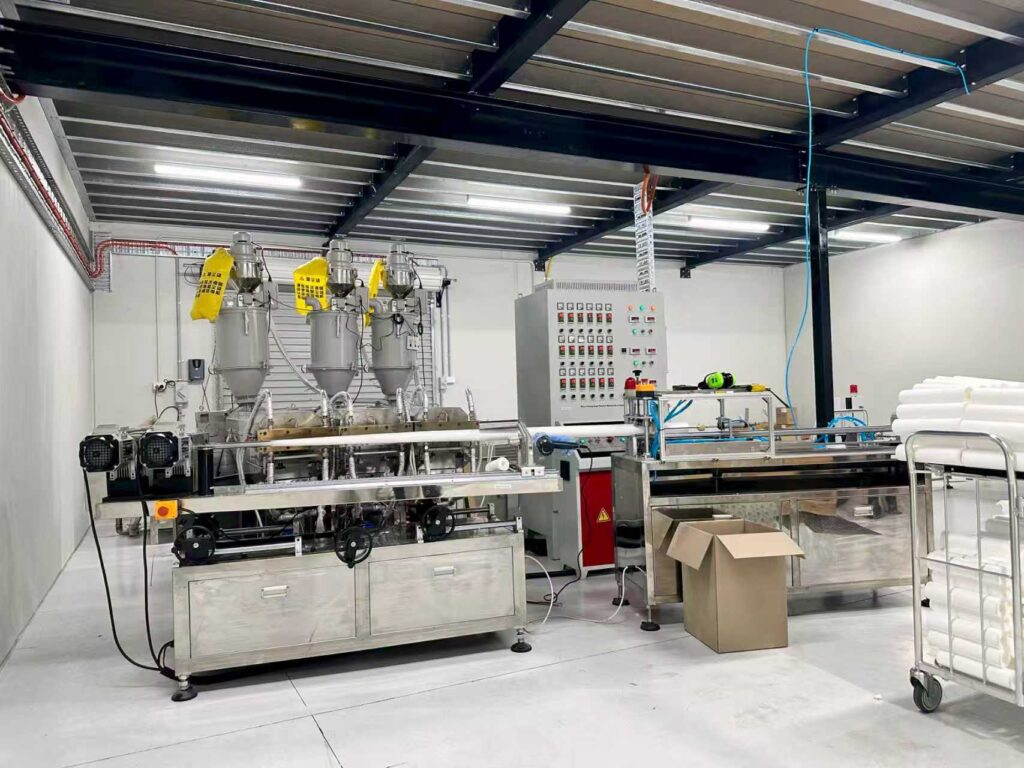
HENGTENG Machine, established in 1989, stands as a premier manufacturer of filter cartridge making machines in China. Specializing in PP melt blown, CTO carbon block, and other filter machines, we utilize advanced design and manufacturing processes. Our commitment to quality is reflected in our ISO9001 and CE certifications and our efficient support system, ensuring our clients receive exceptional service from production to installation. By integrating our multi-zone extruder lines, commercial users eliminate the guesswork of defect troubleshooting, guaranteeing consistent, high-yield production runs.
Frequently Asked Questions (FAQ)
What causes pressure drop in a melt blown filter?
High pressure drop is typically caused by manufacturing the fibers too finely and too densely packed, reducing the porosity of the web. This forces the fluid to work harder to pass through the matrix. It can be fixed during production by lowering the hot air velocity to create slightly thicker, more open fibers.
How do I fix polymer “shot” in my extrusion line?
Polymer shot (unfiberized plastic droplets) is fixed by ensuring complete attenuation of the melt. You must either increase the primary hot air pressure to pull the fibers harder, or slightly decrease the extruder temperature to increase the polymer’s melt viscosity, preventing it from snapping into droplets.
Why are my PP spun filters brittle and cracking?
Brittleness is a direct result of thermal degradation of the polypropylene resin. If the extruder barrel temperatures are set too high, or if the polymer residence time in the barrel is too long, the molecular chains of the PP break down, destroying its mechanical strength. Lowering barrel temperatures resolves this issue.
Is it worth upgrading to a 3-zone melt blown machine?
Yes, for commercial users, it is highly recommended. A 3-zone machine uses three independent extruders to create a true gradient density filter (coarse outer layer, medium middle, fine inner core). This drastically improves dirt holding capacity and prevents the filter from collapsing under pressure, compared to a single-zone machine.
Authoritative References
To ensure our manufacturing diagnostics align with global water safety and material science benchmarks, we rely on standards set by the following organizations: